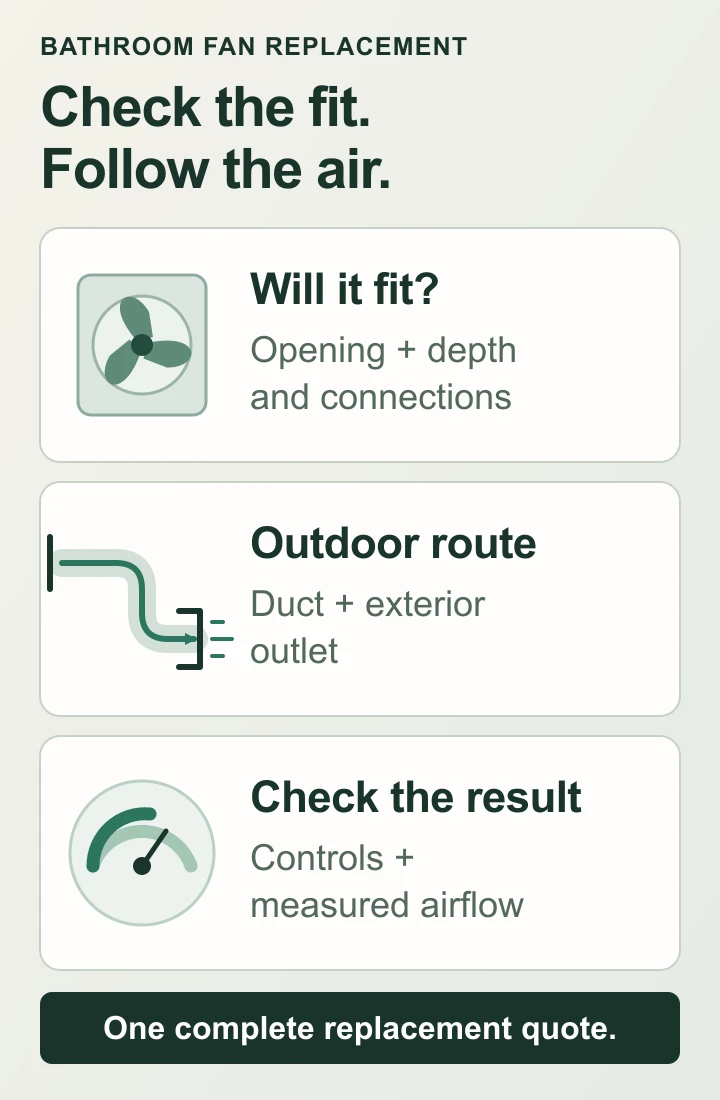
Start by identifying the existing fan and whether the job is a compatible-part repair or a complete replacement. Check the new housing, access, duct route, controls and installed airflow together. HVI’s intermittent (on-demand) small-bathroom guidance starts at one CFM per square foot with a 50-CFM minimum. Continuous ventilation needs a separate specification; a product rating alone does not establish the result in your room.
Before replacing a bathroom exhaust fan, find out what is actually being replaced. A new motor assembly, a complete fan housing and a new duct route are different jobs. Getting that distinction onto the proposal helps you avoid buying a quieter-looking unit while leaving the original airflow problem unresolved.
Start with the symptom: excessive noise, a failed component, lingering shower moisture or a fan that no longer suits the remodeled room. Record when it happens and what you want improved. Then work through the fit, airflow and controls together.
Choose the replacement scope before the product
Ask the installer to identify the existing manufacturer and model, then separate a possible compatible-part repair from a complete fan replacement. A replacement part needs to match the actual unit. A similar grille or a familiar brand name is not enough information to order from.
Have the proposal name what stays: the housing, duct, outside termination, electrical supply and controls. Beside each retained component, record what was checked. If it has not been inspected, mark it as awaiting verification rather than quietly treating it as serviceable.
This creates three useful choices: repair a confirmed component fault; replace the fan while keeping verified connections; or replace the fan and correct associated duct or control work. Ask which choice addresses the problem you described, and what evidence supports it.
Measure the housing, not just the cover
The decorative cover can conceal an opening much smaller than itself. For a concrete manufacturer example, the Broan-NuTone BE8 specification lists a 9.75-inch-square grille and a housing measuring 7.5 by 7.25 by 5.75 inches. Those are different dimensions serving different purposes; they are not a cutting template for another fan.
Ask the installer to record the existing opening, available depth, mounting conditions and duct connection against the proposed model's installation drawing. Include how the surrounding ceiling will be finished if the opening changes. In a remodel, coordinate this before the ceiling is patched and painted.
Access matters too. Broan's AER110LK page describes a model designed for replacement from the room side without attic access. That is a product-specific installation feature, not proof that every replacement can be completed from below. Ask how the selected unit and your existing connections will be reached.
Use CFM for an on-demand sizing starting point
CFM means cubic feet of air per minute. For smaller bathrooms, HVI's intermittent (on-demand) ventilation guidance uses one CFM per square foot, with a 50-CFM minimum. The examples below apply to that operating mode. Continuous ventilation needs a separate specification. Discuss the calculation with the installer alongside the requirements that apply to the property.
| Room dimensions | Floor area | Starting airflow |
|---|---|---|
| 5 × 8 feet | 40 square feet | 50 CFM, using the minimum |
| 7 × 10 feet | 70 square feet | 70 CFM |
| 8 × 12 feet | 96 square feet | 96 CFM |
For intermittent ventilation in a bathroom over 100 square feet, HVI recommends a fixture-based calculation: 50 CFM each for a toilet, shower or ordinary bathtub, and 100 CFM for a jetted tub. A hypothetical 12-by-11-foot room containing a toilet, shower and ordinary tub therefore starts at 150 CFM using that method. Ask how an enclosed toilet compartment is handled.
Write down ceiling height and special bathing features as well. HVI notes that ceilings above eight feet can require additional ventilation. Do not simply copy the previous fan's label when the room or its use is changing.
Trace the duct all the way outside
A higher fan rating does not establish that the existing route will deliver it. The DOE-funded Building America guide calls for outdoor discharge, the manufacturer's specified duct size and a direct route with few bends. An attic or ceiling cavity is not the discharge destination.
Ask the installer to identify the duct diameter, condition, route, connections and outside termination. Have them explain any proposed adapter rather than assuming an old connection will suit the new unit. Keep repair or replacement of these items visible in the quote.
The same guide distinguishes a product's rated airflow from the result after installation: ductwork and termination choices can reduce delivered airflow. Ask how that result will be checked. A fan making noise proves that something is running; it does not provide a measured airflow number.
Compare sound at the setting you will use
Bathroom fan sound is commonly reported in sones. Compare the proposed model's airflow and sound ratings at the same operating setting, rather than choosing from a single large CFM number or an isolated quietness claim.
The ENERGY STAR product criteria assess sound, efficiency and performance under specified test conditions. Those product ratings help compare candidates; they do not replace checking the actual installation.
A selectable-speed example makes the comparison clear. Broan-NuTone's AE50110DCL product page reports different sound figures for its 50-, 80- and 110-CFM settings. Record the setting intended for your room, not only the quietest figure anywhere on the page.
Specify the control and completion check
Decide how the fan will run during and after bathing. For intermittent use, HVI recommends a timer or another control that keeps ventilation running for at least 20 minutes after bathroom use. Agree the chosen control and operating setup with the installer instead of leaving an unidentified switch allowance in the bid.
If the existing fan also provides continuous whole-house ventilation, say so before changing it. A replacement has to preserve that system's intended function. List any requested light, humidity sensing or other feature separately so the selected model and control requirements can be checked together.
Ask what completion evidence you receive. The DOE Home Improvement Expert checklist includes checking the outside damper and measuring airflow with suitable equipment. Its checklist also addresses control setup and maintenance. Use it to frame the handover conversation, not to claim that your installation has already passed.
Give every bidder the same replacement record
| Decision | Record in the proposal | Question to settle |
|---|---|---|
| Existing unit | Manufacturer, model and fault observed | Part repair or complete replacement? |
| Fit and access | Opening, depth, mounting and access route | What ceiling work is included? |
| Airflow | Room calculation and selected operating setting | What target will the installed system meet? |
| Duct and outlet | Retained items, corrections and outdoor destination | What was checked rather than assumed? |
| Controls | Named control and intended operation | Does the existing fan serve another ventilation function? |
| Completion | Airflow check, control demonstration and maintenance information | Who provides the record? |
Put electrical work, any wall or roof opening, and making good into the named trade scope. Use the bathroom permit guide to check local approval responsibilities. Keep unresolved existing conditions identified before work starts.
You can send this brief with your bathroom project details:
“Please quote the fan replacement and identify the existing model, proposed unit, access method, retained duct and any corrections. Include the control, surrounding finishing work and the installed airflow check. Please identify assumptions that still need a site inspection.”
Compare the answers with the same-scope quote worksheet. You will be comparing a defined replacement job, with its connections and finish work accounted for, rather than two fan boxes with different prices.
If the ceiling also needs repainting, choose the coating and return-to-use schedule after the moisture problem is resolved. A paint finish and a ventilation repair answer different parts of the project.
Questions homeowners ask
Can I replace a bathroom exhaust fan without attic access?
Some fans are specifically designed for room-side replacement. Verify the selected model, mounting space and access to your existing connections; the feature is not universal.
What size replacement fan does a 5-by-8-foot bathroom need?
For intermittent (on-demand) operation, HVI’s small-bathroom guidance applies a 50-CFM minimum to this 40-square-foot room. Continuous ventilation needs its own specification. Have the installer check the required installed airflow, duct route and local requirements before selecting the replacement.
Does a bigger fan fix poor bathroom ventilation?
Not automatically. The existing duct, outside outlet, operating controls and other conditions need checking. Compare the required airflow with the system’s measured result, not only the number on the fan box.
Does the new fan cover need to match the old cover size?
Cover dimensions alone do not establish a fit. Check the housing, ceiling opening, available depth, mounting and duct connection against the selected product’s installation information.
Sources & further reading
Primary sources support the factual points in this guide. Local rules and project requirements can change; use the linked authority for a current decision.
- HVI: How Much Ventilation Do I Need?
- HVI: Bathroom Exhaust Fans
- DOE / PNNL Building America: Bathroom Exhaust Fans
- DOE Home Improvement Expert: Bathroom Exhaust Fan checklist
- ENERGY STAR: Ventilation Fans Key Product Criteria
- Broan-NuTone BE8: product dimensions
- Broan-NuTone AER110LK: room-side replacement
- Broan-NuTone AE50110DCL: selectable airflow and sound
MAKE YOUR NEXT MOVE
Get your bathroom remodel moving.
You have done the research. Now choose your project, pick your look, and connect with bathroom contractors for the work you want done.
Start my bathroom project Already have bids? Compare them here ↗