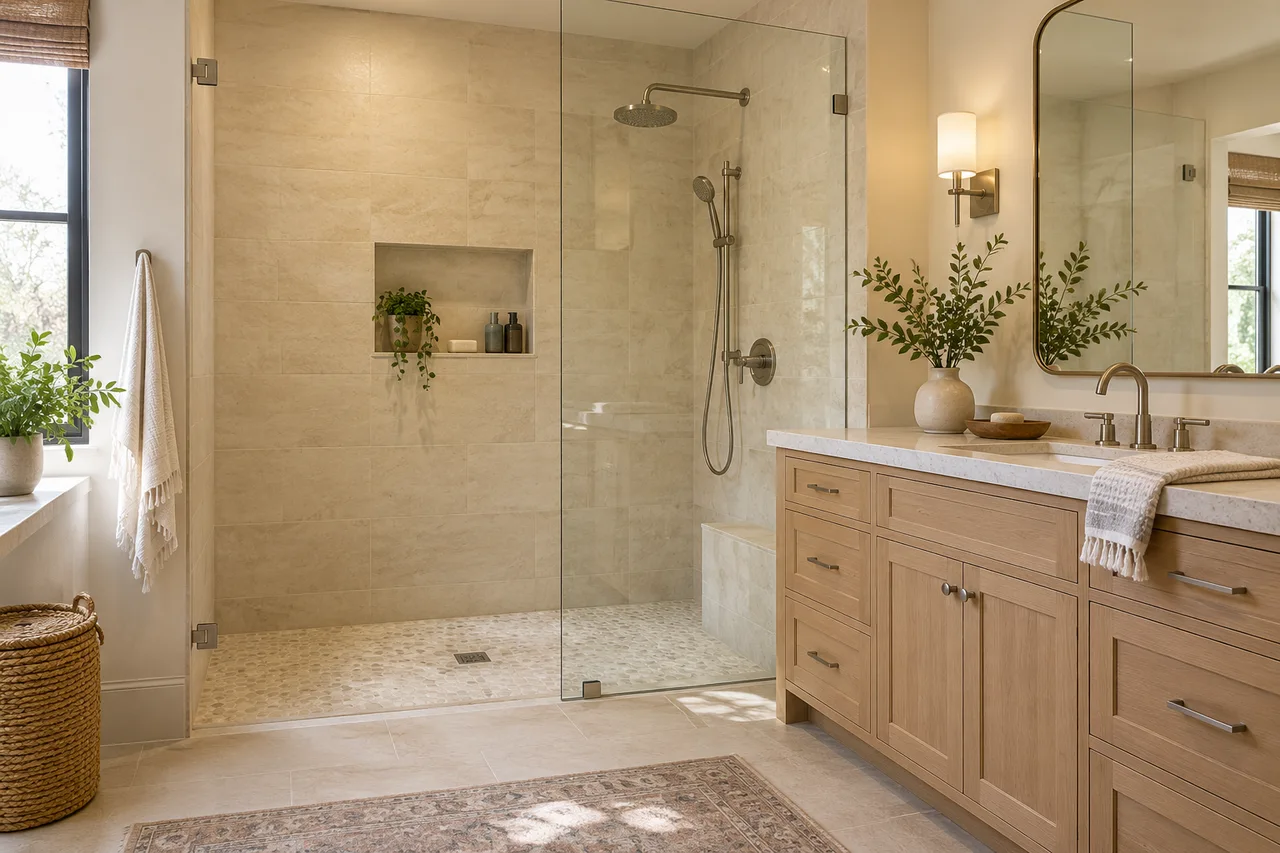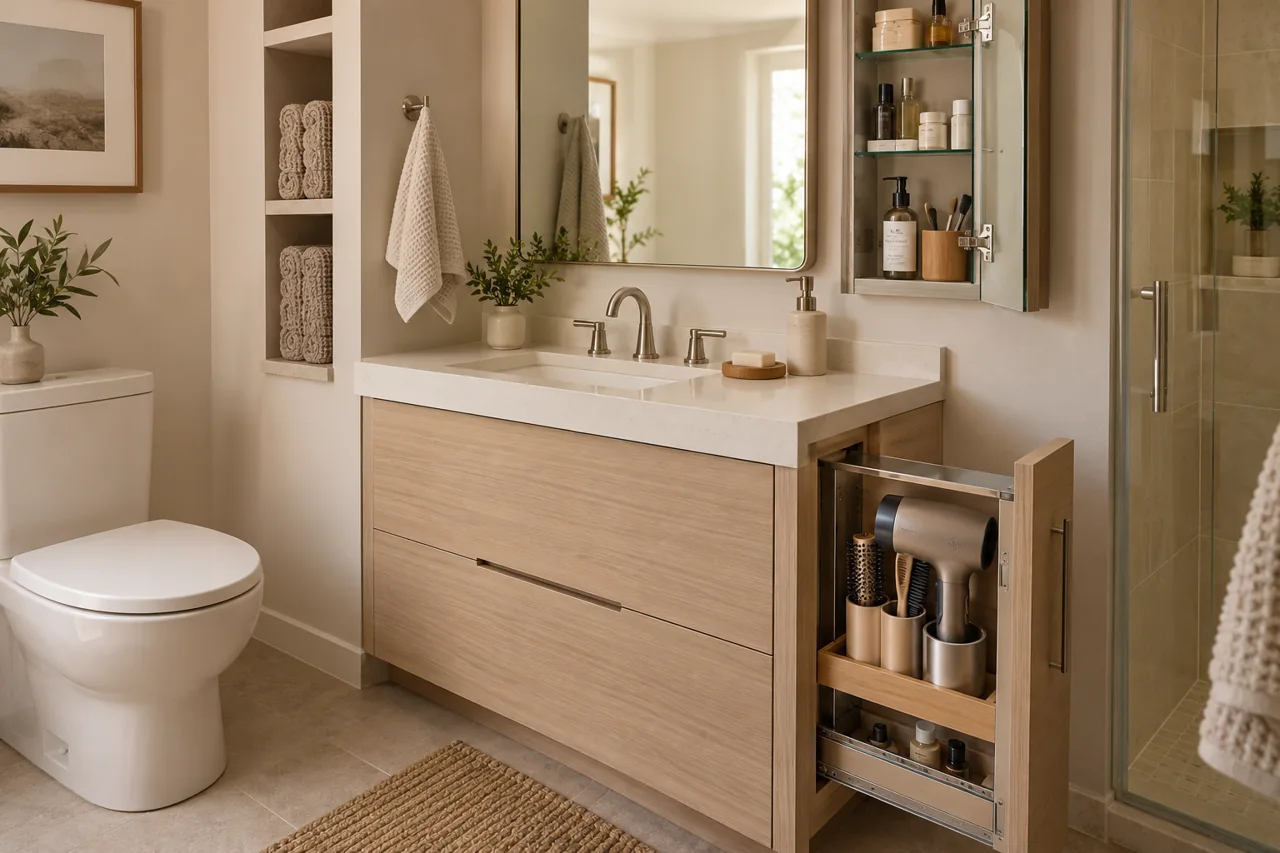
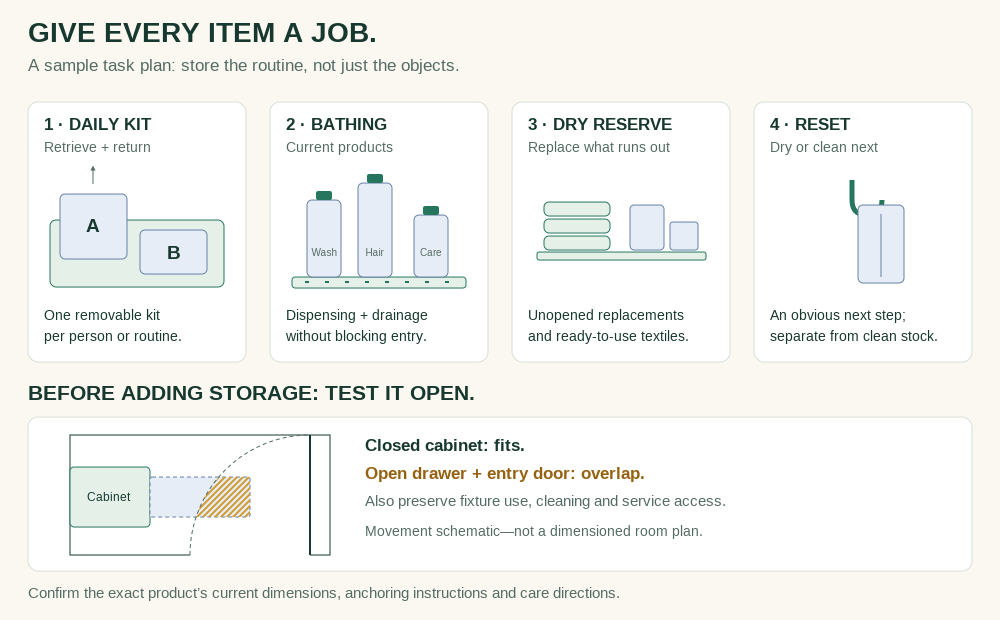
Assign each item a job and a location: daily supplies near their point of use, current bathing products in compatible wet-area storage, replacements in a separate reserve, and a clear reset place for damp or dirty items. Then test the selected storage open as well as closed.
BEFORE YOU HIRE
See a new look in your own bathroom.
Choose your upgrade and the style you want. Add your bathroom photo for a redesign preview, then take the next step with contractor options.
See my bathroom upgradeThe best small bathroom storage gives each item a useful place at the moment it is needed. Keep the daily kit near the sink, bathing supplies at the bathing area, dry replacements in a separate reserve, and a deliberate place for items waiting to dry or be cleaned. Buy storage after deciding those jobs.
A clever cabinet is not helping if its door blocks the toilet or its deepest corner hides supplies you already own. This guide starts with the contents, then matches them to compact storage ideas—including shallow mirror storage, removable routine kits and an honest way to evaluate narrow gaps.
Make a routine map instead of a shopping list
Empty one storage area at a time and group items by their next use. Toothbrush supplies and shaving items may share a morning kit; a spare shampoo bottle belongs in reserve rather than competing with the bottle in use. Remove expired or unwanted items according to their labels and local disposal instructions. Do not buy baskets to preserve a collection you no longer need.
For a shared room, assign each person a small removable kit rather than giving everyone a deep, mixed drawer. Each kit should return to one home after use. That makes “the counter is full” a problem you can trace: too many daily items, no return location, or a cabinet that is awkward to use.
| Group | Example contents | Useful location | Test before buying |
|---|---|---|---|
| Daily sink kit | Current toothbrush supplies, shaving or face-care items | Shallow cabinet or removable front-of-drawer tray | Can one person retrieve and return it without unloading another kit? |
| Bathing kit | Current wash products and bathing accessories | Compatible shower shelf or caddy | Can bottles stand, dispense and drain without crowding the entry? |
| Dry reserve | Unopened replacements and ready-to-use textiles | Separate shelf or labeled container | Is reserve stock hiding frequently used items? |
| Reset zone | Damp items awaiting drying; items awaiting cleaning | Dedicated hook or other suitable staging place | Is the next step obvious, rather than mixed into the clean reserve? |
Use the mirror wall for a shallow daily kit
A shallow mirror cabinet can hold small daily items without using the whole sink counter. It works particularly well when the shelf arrangement fits what you actually stand upright. Check the tallest bottle, the usable shelf depth and the door's travel; the cabinet's outside dimensions do not describe every internal opening.
As a real size example, IKEA lists the ENHET 706.230.43 mirror cabinet at 18 inches wide, 6⅝ inches deep and 30 inches high. Those are external dimensions. Make a paper outline of its projection over the sink and test head position while leaning forward. An attractive mirror is not automatically comfortable above every basin.
Surface-mounted and recessed cabinets create different installation questions. Do not assume a wall cavity is empty or that an existing recess accepts a new model. The manufacturer's assembly instructions require suitable wall attachment and assessment of the wall and intended load. Have concealed services and mounting conditions checked before installation.
Before choosing the mounting method, work through the recessed versus surface-mount medicine cabinet checks. They separate wall fit, installed projection and door movement so a storage choice works both behind and in front of the mirror.
Turn one awkward vanity into two useful routine kits
Instead of adding several permanent organizers immediately, try two open-top containers you can remove independently. In a hypothetical household, one holds the morning grooming routine and the other holds occasional items. Put reserve products behind them only if they remain visible and reachable.
Under a sink, the drain and supply arrangement may interrupt an otherwise rectangular space. Leave the access the installer requires; do not build an organizer tightly around a connection that needs servicing. A removable kit can be lifted out when access is needed. Test the container with its contents, not empty: a tall pump bottle may fit inside but be inconvenient to lift through the cabinet opening.
For hair tools, compare a vertical holder with a lift-out tray using the actual unplugged, cool tools and their cords. Follow each appliance's storage and cooling instructions. The goal is a tidy return location, not a concealed electrical charging station built around assumptions.
Make the narrow gap prove that it deserves storage
There are two questions: can the unit occupy the gap, and can someone use it there? A rack wedged beside a toilet might store bottles while making floor cleaning or fixture access harder. A slim cabinet near the entrance may fit closed but collide with the room door when opened.
Consider the VESKEN 403.078.66 shelf as a dimensional example. The current US page's Measurements section lists 14½ inches wide, 9⅛ inches deep and 39⅝ inches high. A nine-inch-deep strip is therefore smaller than its listed depth. Use the current item number and measurements rather than an older search-result title or a similar-looking version.
IKEA describes drain holes for shower use and requires the provided wall-anchoring safety device. That does not make every position beside a shower suitable. Check the installation instructions, wall attachment, product access and the room's circulation. The shelf's presence must not turn the way into the shower into an obstacle course.
Separate wet-item handling from clean storage
Give a used washcloth, a towel and a cleaning accessory an intentional next step. A hook or suitable drying arrangement serves a different job from a basket of ready-to-use towels. Do not count a hamper or decorative box as a solution without deciding how its contents will be handled.
Follow the care directions for the selected cabinet and shelf. The cited ENHET mirror cabinet instructions call for wiping dry; the VESKEN page also specifies wiping dry and cleaning with a damp soft cloth and mild non-abrasive detergent when needed. Those instructions are more useful than assuming every bathroom product tolerates standing water or the same cleaner.
For shower storage, test the shelf position with the people and bottles that will use it. Our shower niche height and size guide turns those checks into a measured layout brief before framing and waterproofing are finalized.
Reject the storage idea that steals the next movement
Check the room in three states: everything closed, the most-used storage open, and someone using the neighboring fixture. Drawers, mirror doors, entry doors and shower screens need their own movement space. A wall shelf also has a front edge at head or shoulder height; its floor footprint alone does not tell the story.
Above-toilet storage needs the same scrutiny. Check whether the tank lid, flush control and service access remain usable, then review wall attachment and load instructions for the chosen unit. Do not treat a decorative ladder or towel rail as a support for a person's weight unless it was designed and installed for that purpose.
Leave the room with a short, testable storage brief
- Name the routine each proposed unit serves.
- List the actual contents and which items must remain visible.
- Mark door, drawer, body and cleaning movements that must stay possible.
- Record the exact product, current dimensions, wall attachment and care instructions.
- Try removable organization before committing to permanent cabinetry.
If the room still needs a different vanity or bathing layout, compare the 5×8 layout concepts and use our quote worksheet to put the storage work into the contractor's scope. For the room sketch itself, the separate measurement guide covers what to record. This brief's job is deciding what that space should do.
Check the complete replacement vanity assembly before ordering for the next part of your project.
Before fixing a rail in a newly cleared wall space, test the towel drop and everyday reach with the towel you use. Include doors, drawers and the hardware projection rather than judging only a flat empty patch of wall.
Questions homeowners ask
What should I store in a small bathroom's easiest-to-reach space?
Start with the items used in the daily routine. Keep unopened reserve products from displacing them, and give each user or task a kit that can be retrieved and returned without unloading unrelated supplies.
Is a mirror cabinet better than vanity storage?
They serve different items. A shallow mirror cabinet may suit small daily products; a vanity can serve larger supplies. Check usable internal dimensions, door movement, basin position and installation requirements before choosing.
Will a narrow shelving unit fit in a nine-inch gap?
Check the exact current model. The cited VESKEN shelf's US Measurements section lists a depth of 9⅛ inches, so a nine-inch strip is smaller than that dimension. Fit also requires usable access and circulation.
Can bathroom storage go inside a shower?
Only when the selected product and its installation are suitable. The cited VESKEN page describes shower use and drainage holes, but it also requires wall anchoring. Follow the exact model's instructions and keep shower entry and controls usable.
Sources & further reading
Primary sources support the factual points in this guide. Local rules and project requirements can change; use the linked authority for a current decision.
MAKE YOUR NEXT MOVE
See a new look in your own bathroom.
Choose your upgrade and the style you want. Add your bathroom photo for a redesign preview, then take the next step with contractor options.
See my bathroom upgrade Already have bids? Compare them here ↗