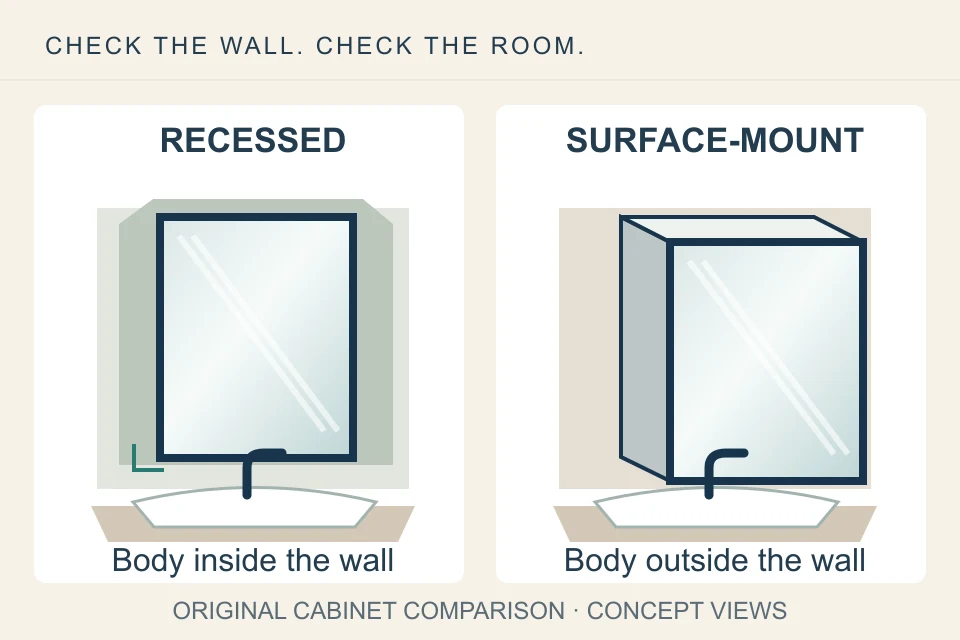
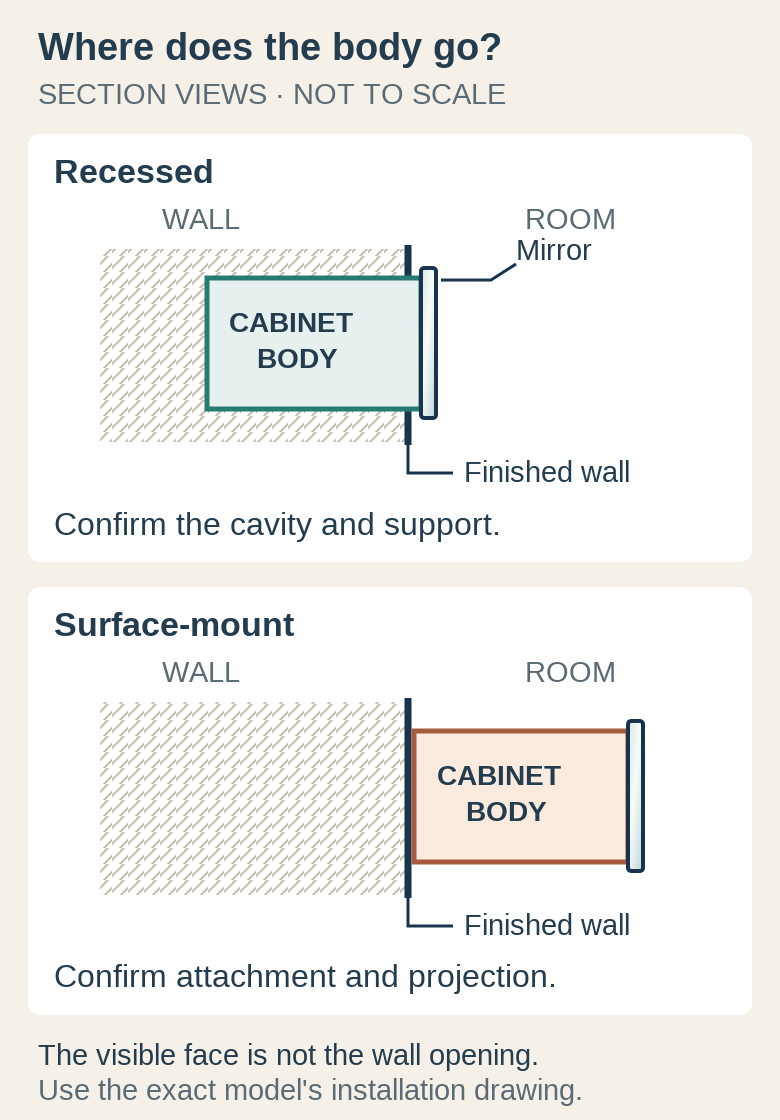
A surface-mount cabinet keeps its body outside the wall cavity but projects into the room. A recessed model puts its body into a prepared wall opening. Choose only after confirming the selected model's wall or attachment requirements, installed projection and door clearance; an outside-size label is not a recess-opening dimension.
Choose a surface-mount medicine cabinet when you want to keep the wall cavity intact and its projection works over the sink. Choose a recessed cabinet when an installer has confirmed the wall can accept it and you want less cabinet projecting into the room. Check those conditions before choosing a mirror size or placing an order.
The expensive surprise is often behind the mirror: a cabinet selected for its front view needs a wall opening, support or service changes that were never in the plan. The opposite mistake happens in front of the wall—a surface-mounted box fits the available rectangle but crowds the faucet, light or person using the basin. You need both views to make a good choice.
What actually changes between the two types?
With a recessed medicine cabinet, the storage body occupies a prepared opening in the wall. With a surface-mount cabinet, the body sits on the room side of the wall. The mirror and trim can still project on a recessed design; “recessed” does not promise that every visible edge disappears into the finish.
KOHLER's medicine-cabinet buying guide distinguishes the two mounting arrangements and shows side kits used to finish exposed cabinet sides. A side kit changes the appearance of a surface installation; it does not move the cabinet body into the wall.
| Your priority | Start by investigating | What could change that choice |
|---|---|---|
| Keep an otherwise finished wall | A surface-mount model and its attachment requirements | Its depth or open door interferes with the sink, lighting or movement. |
| Reduce the cabinet's room-side projection | A recessed model with confirmed wall fit | Concealed conditions or the required wall work make the recess impractical. |
| Replace an existing recessed cabinet | The old opening and the new model's installation drawing | The new body, trim, support or attachment points do not match. |
| Choose the appearance before opening the wall | An exact model approved for both mounting methods | Its kit, clearances or installation requirements differ between methods. |
Neither category is automatically better made, more spacious or easier to live with. Compare the actual candidates and the work they need in your room. A model that allows both methods can preserve a choice; a similar-looking cabinet might permit only one.
Read the opening drawing, not just the shopping label
A product's advertised width and height describe its outside size, not necessarily the hole needed for recessing it. For example, the KOHLER K-CB-CLC2026FS specification identifies a 20-by-26-inch cabinet and separately lists a cutout. Treat those as different entries on your comparison, not interchangeable measurements.
Save the exact model number, specification sheet and installation instructions together. Check that they describe the version you are buying. Ask the installer to reconcile any disagreement between a retailer's chart, an older PDF and the supplied instructions before making an opening. Do not pick the dimension that happens to suit the wall.
For a recessed candidate, ask which dimensions describe the cabinet body, required opening and visible face, and where the depth is measured from. For a surface candidate, ask for the complete installed projection, including the selected door, trim and side treatment. A useful comparison keeps these product-specific dimensions beside the drawing they came from.
Test the projection and the door before you commit
Make a paper outline of the mirror face and a lightweight cardboard profile showing the proposed projection. Hold or support the mock-up safely; this is a shape check, not a temporary cabinet installation. Stand where you wash, brush and shave. Lean toward the basin as you ordinarily would. Does the proposed front edge make that movement uncomfortable?
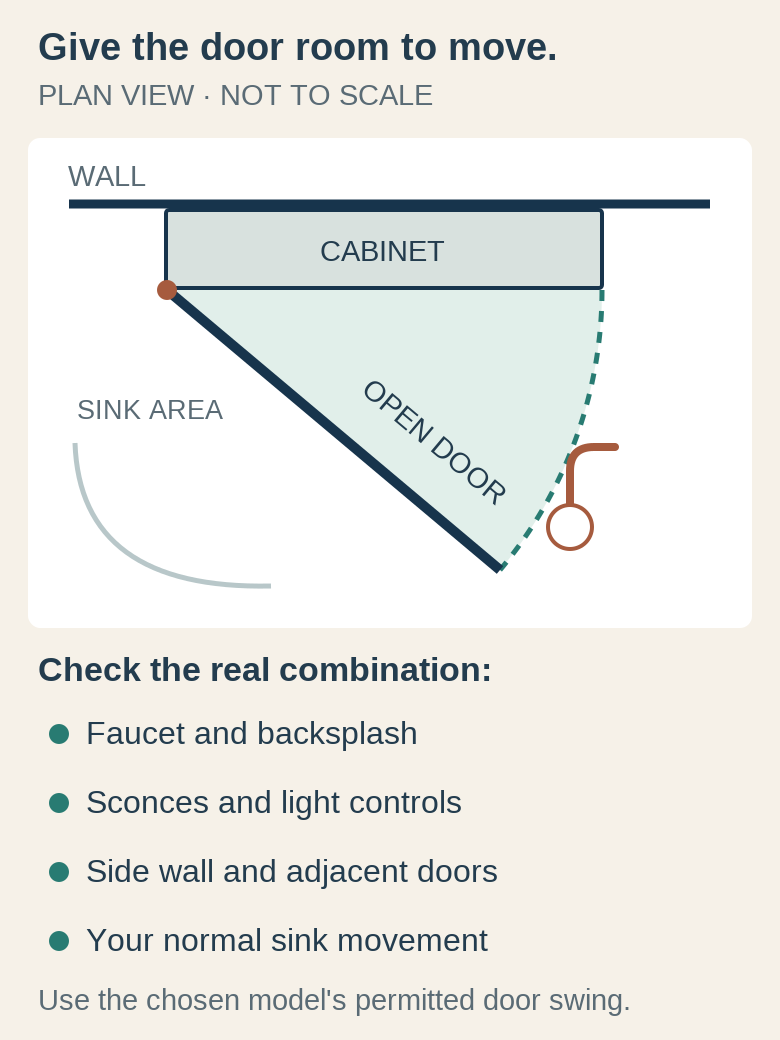
Then show the door's path from the selected model's drawing. Try the permitted hinge orientation rather than assuming every door reverses. Check the side wall, sconces, faucet and other cabinet doors. For a double vanity, check the neighboring mirror door too. A cabinet can look centered when closed while being awkward to open.
Look at the light from that same position. Can you reach its control, clean around it and use the mirror without the cabinet creating a new obstruction? If changing the vanity or faucet as well, mock up the proposed combination. The old faucet is a poor stand-in for a much taller replacement.
KOHLER's cited cabinet specification and installation guide 1133135-2-K include clearance requirements. Use those for the applicable cabinet as well as your comfort test. A paper mock-up cannot waive the manufacturer's clearances.
Get the wall question answered before ordering a recess
Have the installer establish what is known about the proposed wall: the available cavity, support, concealed services and any remaining investigation. A clear space on the bathroom side is not proof of an empty cavity. Nor does finding a stud prove that the chosen opening can be made.
The cited KOHLER installation guide requires framing and attachment to framing for its recessed installation. It also identifies concealed electrical and water services, drain or vent pipes and a load-bearing wall as conditions that need attention. Have the appropriate qualified installer or trade resolve those conditions; do not cut a stud or relocate a service to make a purchase fit.
If it is an exterior wall or a wall with a required protective assembly, specifically ask what making the recess would change. Record the answer for this wall rather than borrowing a detail from a different bathroom. It may be more sensible to choose surface mounting or a different position than to expand a small storage project into wall reconstruction.
Surface mounting still needs suitable support and fixings. The same KOHLER guide calls for anchors appropriate to the loaded product where required. Ask the installer to confirm the selected unit's attachment against the actual wall; keeping the cavity intact does not mean fastening anywhere is acceptable.
An existing recess is a head start, not a guaranteed fit
For a replacement, record the existing cabinet model if it can be identified, photographs and dimensions the installer can safely establish. Note what is still concealed. Have the old opening and support assessed before treating them as ready for the new cabinet.
A wider mirror face can hide a smaller body. A replacement with similar outside dimensions may need a different opening or leave an exposed border. Ask how the new trim meets the existing finish and who repairs any uncovered wall, tile or old fixing marks.
Do not use trim coverage as the test for secure mounting. The installer needs to confirm both the fit and the attachment. Likewise, changing from recessed to surface-mount is not just hanging a larger mirror over the old hole: include whatever opening restoration and support the chosen installation requires in the proposal.
Keep surrounding work visible. If this change is part of a vanity replacement, settle the mirror, faucet and top together. For the cabinet's contents and shelf layout, use the separate small-bathroom storage guide. This decision is about which mounting arrangement the room can accept.
A lighted or powered cabinet changes the brief
Identify integrated lighting, outlets or other powered features by exact model before asking for an installation price. Send the applicable electrical instructions to the responsible installer. Ask where the supply and controls must be, what can remain and which work belongs to the qualified electrical trade. Do not assume a powered model connects the same way as an unpowered cabinet or a separate vanity light.
Record any required compatible kit as well. The goal is one complete, installable selection—not a cabinet now and a search for missing mounting, side or electrical components after delivery. Keep the lighting decision with the room plan so the mirror and light are not ordered independently and discovered to conflict.
Use four checks to release the order
Before buying, put the chosen cabinet and mounting method on a single short record. These four checks make the order easier for both the household and installer to approve:
- Product confirmed: exact model, allowed mounting method, current drawing and instructions, required kits and included parts.
- Room confirmed: face position, installed projection, useful mirror view and permitted door swing work with the faucet, lighting and daily movement.
- Wall confirmed: the installer has identified the support, opening or attachment work and any concealed condition still awaiting investigation.
- Scope confirmed: removal, service work, wall restoration, finish repairs and completion checks have named responsibilities.
If the wall check is unresolved, keep the recessed choice provisional. If the projection fails, reconsider the surface candidate rather than trying to get used to an obstruction. If both work, you can finally choose on the appearance and interior arrangement you prefer.
Use the same-scope quote worksheet when the work goes out for pricing. A good result is not simply a cabinet that fits the wall: it fits the room's routine, opens properly and arrives with an agreed installation scope.
Questions homeowners ask
Is a recessed medicine cabinet better than a surface-mount cabinet?
It depends on the wall and the space in front of it. Recessing reduces the cabinet body projecting into the room but requires a suitable prepared opening. Surface mounting keeps the body outside that cavity but needs a projection and door-swing check. Compare the actual models and installed work, not the category alone.
Can I use a cabinet's advertised size as the recessed opening size?
No. The cabinet face, body and required opening can have different dimensions. Use the exact model's current installation drawing and instructions, and have the installer resolve conflicting dimensions before work. Do not cut from a shopping-page size label.
Can a recessed medicine cabinet be installed on any wall?
The proposed wall has to suit the selected product and its installation requirements. Have the installer assess the cavity, framing or other support and concealed services. Exterior or protected wall assemblies need their own assessment. Surface mounting or another position may be a better choice.
Can I surface-mount a cabinet sold as recessed?
Only if the manufacturer permits surface mounting for that exact model and the required mounting and finishing components are available. A cabinet that looks similar to a dual-mount model is not proof that it can use the same method.
Will a new cabinet fit the old medicine-cabinet recess?
Not necessarily. Compare the existing opening, depth, support and finish with the new model's body, required opening, attachment and trim. Include any wall restoration or exposed border repair in the installation scope.
Sources & further reading
Primary sources support the factual points in this guide. Local rules and project requirements can change; use the linked authority for a current decision.
MAKE YOUR NEXT MOVE
Get your bathroom remodel moving.
You have done the research. Now choose your project, pick your look, and connect with bathroom contractors for the work you want done.
Start my bathroom project Already have bids? Compare them here ↗