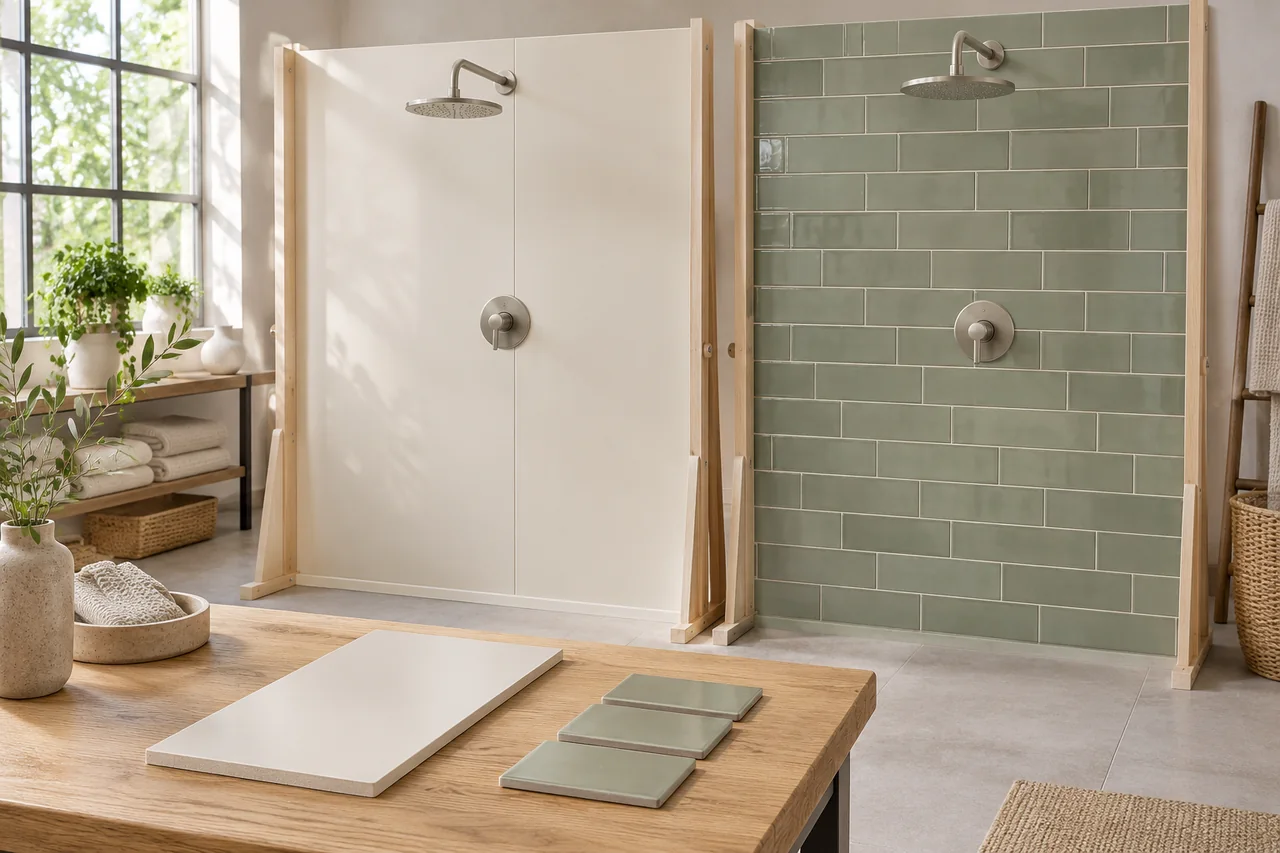
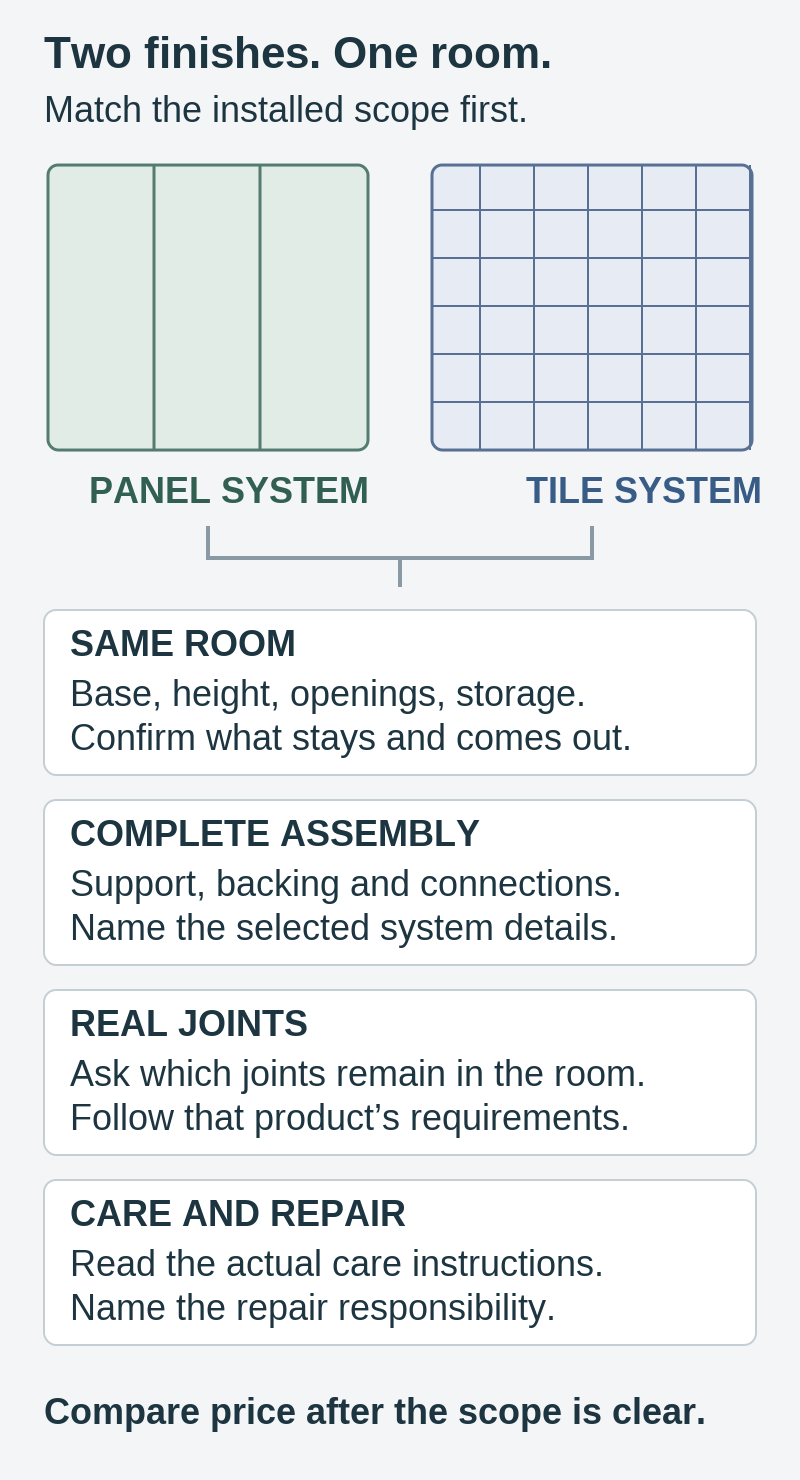
Choose between panels and tile after both proposals describe the same room, preparation, base connection, joints and finishing. Then compare the actual appearance, care instructions, repair responsibilities and complete installed price. Acrylic and other panel systems have different requirements; neither “panels” nor “tile” names a complete installation.
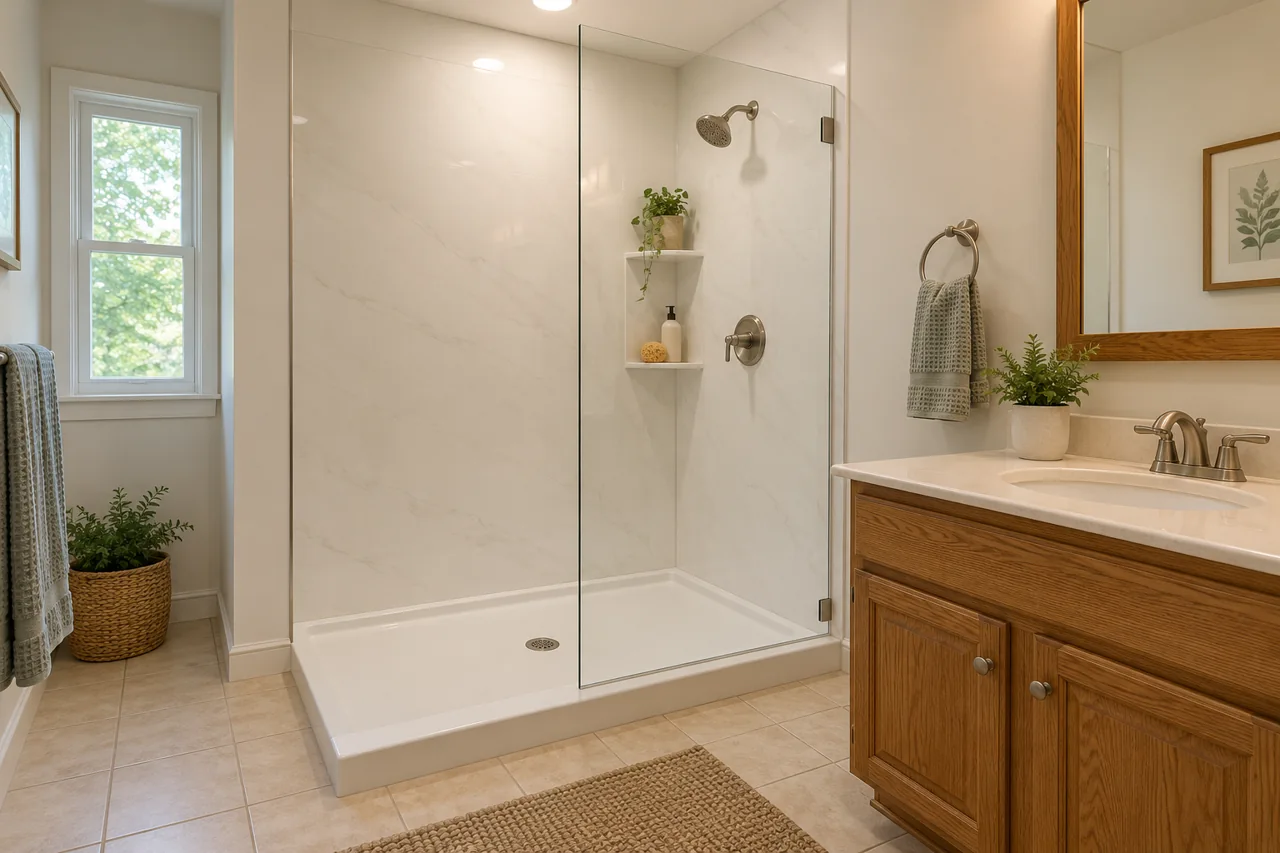
Compare a finished panel shower with a finished tile shower—not a wall kit with a box of tile. Put both proposals on the same room plan and ask what each includes behind the surface, at the joints and around the fixtures. Then compare the appearance, care routine and written installed price.
Acrylic is one panel material; “shower wall panels” also includes other materials and systems. The name alone does not tell you whether a product fixes to studs, bonds to prepared backing, can be trimmed or uses a particular base. Choose the actual system before drawing conclusions about the entire category.
Start with the same room, not two different packages
Give each installer the same outline: the bathing area, retained or replaced base, wall height, valve location, window and any niche or seat. Add the enclosure and storage you want. A panel quote with a new base and glass is a different package from a tile quote that keeps both.
Ask each bidder to mark what comes out, what stays and which existing conditions still need checking. This is where a comparison becomes useful. A simple room can suit several approaches; a window, unusual angle or retained component can change the shortlist.
Check the exact product's limits. The MAAX Utile FAQ, for example, says its panels cannot be cut to change their dimensions or fit around a window. That is a constraint of that system, not a rule for every wall panel. Ask for a confirmed fit rather than an assumption that any sheet can be cut to any room.
Put the entire wall assembly on the comparison sheet
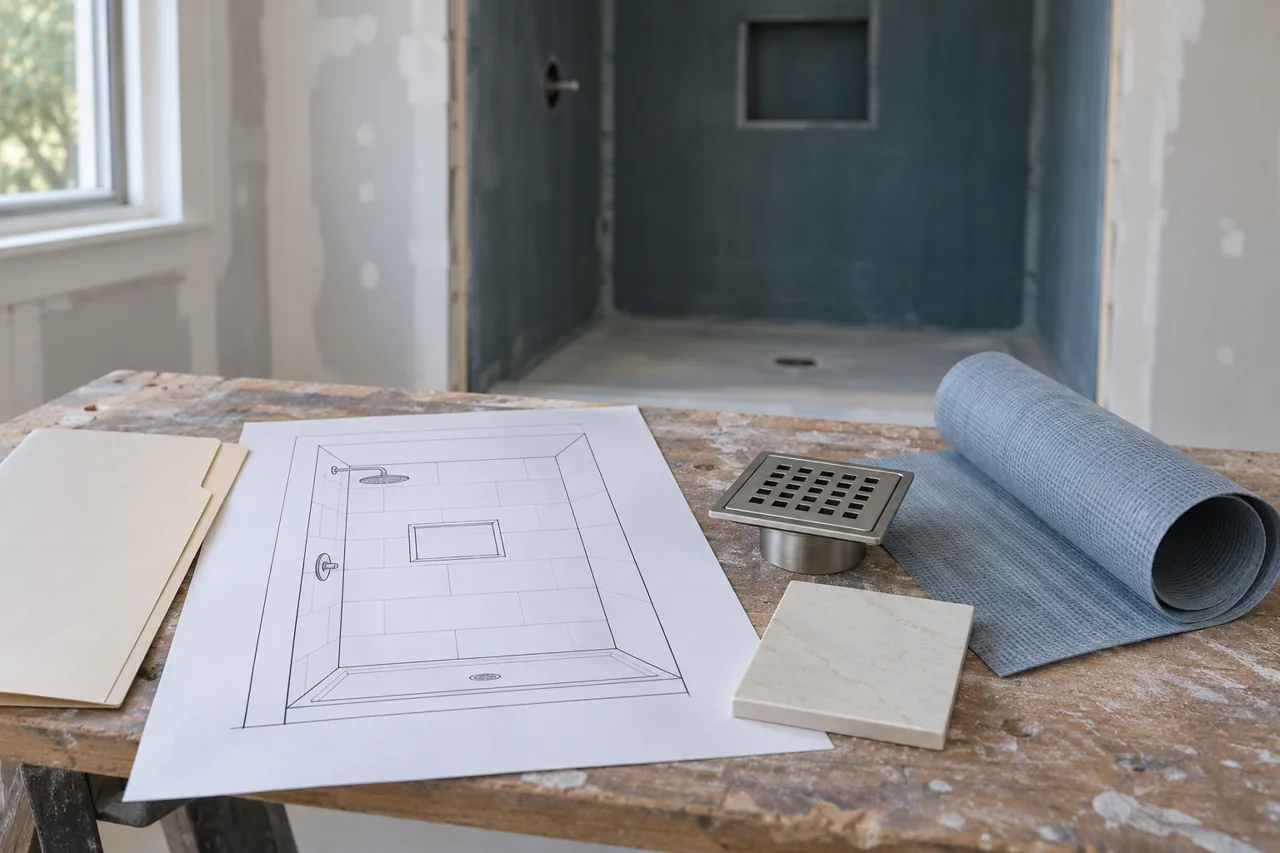
Request the selected panel or tile, the support and backing it requires, the water-management approach, connection details and finishing around the perimeter. Name the base or tub it joins. “Waterproof walls” is too broad to show what the installer is proposing.
For a tiled system, Schluter's KERDI instructions describe a membrane and its seams, corners and connections. Tile selection is therefore only part of that particular assembly. Other systems have their own requirements; ask which instructions apply to yours.
| Decision | Panel proposal | Tile proposal |
|---|---|---|
| Room fit | Named kit, sizes, permitted cuts and openings | Selected tile, layout and treatment at openings and edges |
| Support | Required framing or prepared backing; included correction work | Specified substrate and preparation; included correction work |
| Water connections | Product-specific joins, base connection, perimeter and penetrations | Specified waterproofing, drain/base connection and joints |
| Daily care | Care instructions for the actual surface and seals | Care instructions for the selected tile, grout and sealant |
| Repair responsibility | Who assesses damage and which component can be repaired or replaced | Who assesses the finish and underlying assembly before repair |
| Complete price | Removal, preparation, fixtures, glass, finishing and stated exclusions | The same written scope, with allowances and exclusions identified |
Use “included,” “excluded” or “not yet confirmed” in each cell. Do not award points for a blank. The same-scope quote worksheet helps once those packages are described on an equal basis.
Look at the real joints—not just the grout pattern
A surface can imitate tile without using individual tiles and grout joints. That does not tell you how its actual panel connections and edges are managed. Ask the installer to identify the joints in your selected system and explain what remains visible.
Two manufacturer examples show why the detail matters. Delta describes its Classic 500 acrylic system as having caulkless interior seams when used with the matching tub or base, while still recommending sealing at the finished-wall perimeter. MAAX's Utile FAQ calls for silicone at the specified joints. These are different product details, not competing universal rules.
For tile, ask which joints use grout, which use another specified treatment and how the waterproofing interfaces are handled. Let the selected system and installer define the detail. Do not decide that an assembly has no maintenance points because the surface has fewer visible lines.
Choose a care routine you will actually follow
Ask for the care sheet before ordering. Read it for the selected material and finish, rather than using a general promise that panels are easy or tile is difficult.
Delta's acrylic-care guidance recommends non-abrasive cleaning and warns that unsuitable chemicals can damage its named acrylic products. Daltile's ceramic and porcelain guidance says grout still needs periodic cleaning; sealing or using epoxy grout does not guarantee against surface buildup or discoloration. Neither statement creates a universal cleaning recipe.
Make the question practical: which cleaner and tools may be used, which joints need attention, and what happens if the surface or a seal is damaged? If several people clean the bathroom, keep the approved care instructions somewhere they can find them.
Ask how a future repair would be handled
Before choosing either finish, ask a simple scenario question: “If a fitting leaks or this section is damaged, how would you investigate and repair it?” Have the installer distinguish a surface repair from work involving the underlying assembly. Record who you would contact and which written terms cover the proposed work.
Do not assume a large panel must always be replaced, that an individual tile can always be patched without affecting anything behind it, or that a product warranty pays every installation cost. Ask for the actual repair and warranty documents rather than treating those assumptions as product features.
The pre-tile waterproofing record is useful if you choose tile. It addresses documenting the hidden assembly; this comparison addresses which complete wall proposal best fits the room and your expectations.
Choose the proposal whose trade-offs are clear
You may prefer the look and arrangement of tile, or a panel system that suits the room and your care preferences. There is no useful winner until the actual products and installed scope are known.
Keep three things with the final choice: the room-specific proposal, the product and care documents, and a written list of exclusions or unresolved conditions. If the sales conversation emphasizes installation speed, use the one-day remodel scope guide to separate a finish-installation claim from the complete project. Then ask for a complete written proposal for the approach you want.
If you choose tile, use the format and visible-cut comparison before ordering. Compare the actual pieces and joints, then confirm the product and assembly fit for each wall, bathroom floor or shower-floor location.
Questions homeowners ask
Are all shower wall panels acrylic?
No. Wall-panel systems use different materials and construction. Record the actual material and product before comparing fit, care and installation requirements.
Do shower wall panels eliminate every sealant joint?
No universal rule applies. For example, Delta describes caulkless interior seams for a matching Classic 500 assembly while still recommending finished-wall perimeter sealing. Other panel systems specify different joint details.
Is a panel shower always less expensive than tile?
You need comparable written installed proposals to answer that for your project. Compare removal, preparation, base, fixtures, enclosure, finishing and exclusions as well as the wall finish.
Can any panel be cut around a bathroom window?
Check the exact product. MAAX says its Utile panels cannot be cut to change their dimensions or fit around a window. Other products need their own fit and installation check.
Sources & further reading
Primary sources support the factual points in this guide. Local rules and project requirements can change; use the linked authority for a current decision.
MAKE YOUR NEXT MOVE
Get your bathroom remodel moving.
You have done the research. Now choose your project, pick your look, and connect with bathroom contractors for the work you want done.
Start my bathroom project Already have bids? Compare them here ↗