Choose shower grout by its exact product sheet, not just an epoxy, cementitious or ready-to-use label. Check the tiled zone, tile finish, agreed joint dimensions, permitted wet exposure and return-to-use conditions. Keep a compatible sample and a written first-shower and care handoff with the quote.
A grout color card cannot tell you whether a product suits your shower. Before approving a shade, get the proposed product name into the quote and check it against the actual tile and the way the shower will be used. The useful outcome is a small, complete specification you and the installer can both recognize.
Start with a row for each tiled zone
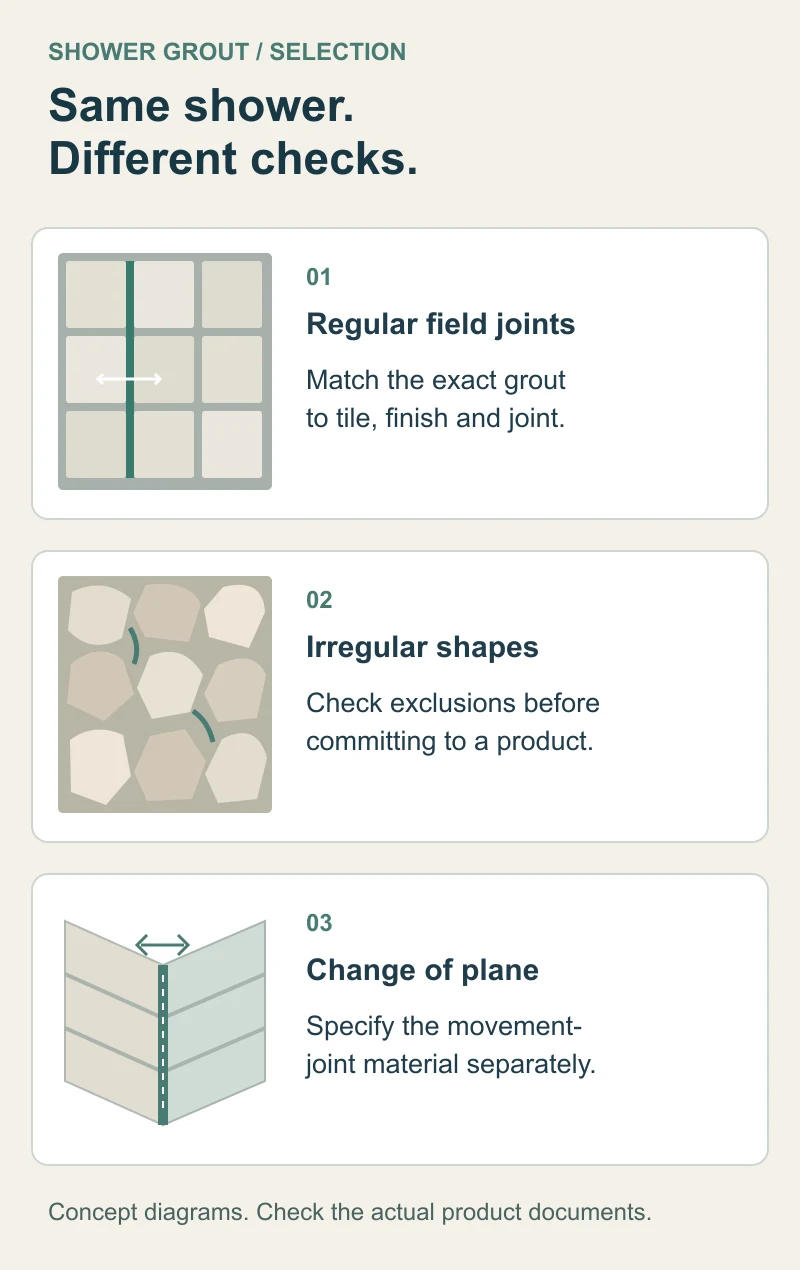
Write down the wall tile, floor tile and any separate feature rather than calling everything “the shower.” Beside each, record the tile maker, model, finish and the joint dimensions proposed by the installer. Add whether the room is an ordinary shower or includes steam. A blank field is a question to resolve before ordering.
Take the agreed joint dimensions into product selection. If the layout is still unsettled, use the tile-size and cut-planning guide first. Choosing a grout around an imagined joint leaves the product check unfinished.
Compare exact products, not just three family names
These current US documents show why cementitious, epoxy and ready-to-use are starting categories. They are examples to investigate, not a performance ranking.
Cementitious example: MAPEI Ultracolor Plus FA
MAPEI Ultracolor Plus FA is a fine-aggregate cementitious example. Its US technical sheet lists 1/16- to 3/4-inch joints for porcelain tile and says sealing is not typically required. The same document calls for checking tile compatibility on separate samples, including susceptible glass, glazed tile and stone. A broad “sanded or unsanded?” question would miss that product-specific combination of aggregate, permitted joint and finish checks. Read the US product sheet.
Epoxy example: LATICRETE SPECTRALOCK PRO Premium
LATICRETE SPECTRALOCK PRO Premium is an epoxy example. DS-681-1026 lists 1/16- to 1/2-inch joints, but also warns about possible scratching of delicate finishes and color effects on white or porous stone. It gives steam-room and submerged work a separate use restriction: 10 days of curing at 70°F (21°C). That instruction is specific to those applications; it is not a universal shower-grout timer. Check the intended exposure and sample result before accepting an epoxy substitution. Read DS-681-1026.
Ready-to-use example: MAPEI Flexcolor CQ
MAPEI Flexcolor CQ is a ready-to-use example whose US sheet permits intermittent wet exposure on shower walls and floors. It excludes pools/hot tubs, steam rooms/saunas, pebble or river-rock mosaics and irregular tile. Read the limitations as well as the headline: they exclude joints whose width or depth equals or exceeds 1/2 inch. A general “suitable for showers” description would hide a poor match for an irregular pebble floor. Read the US product sheet.
Use the same questions for a different brand or model. An installer proposing a substitute should identify what changed and show the applicable document; matching the color does not complete that comparison.
Approve the tile-and-grout combination
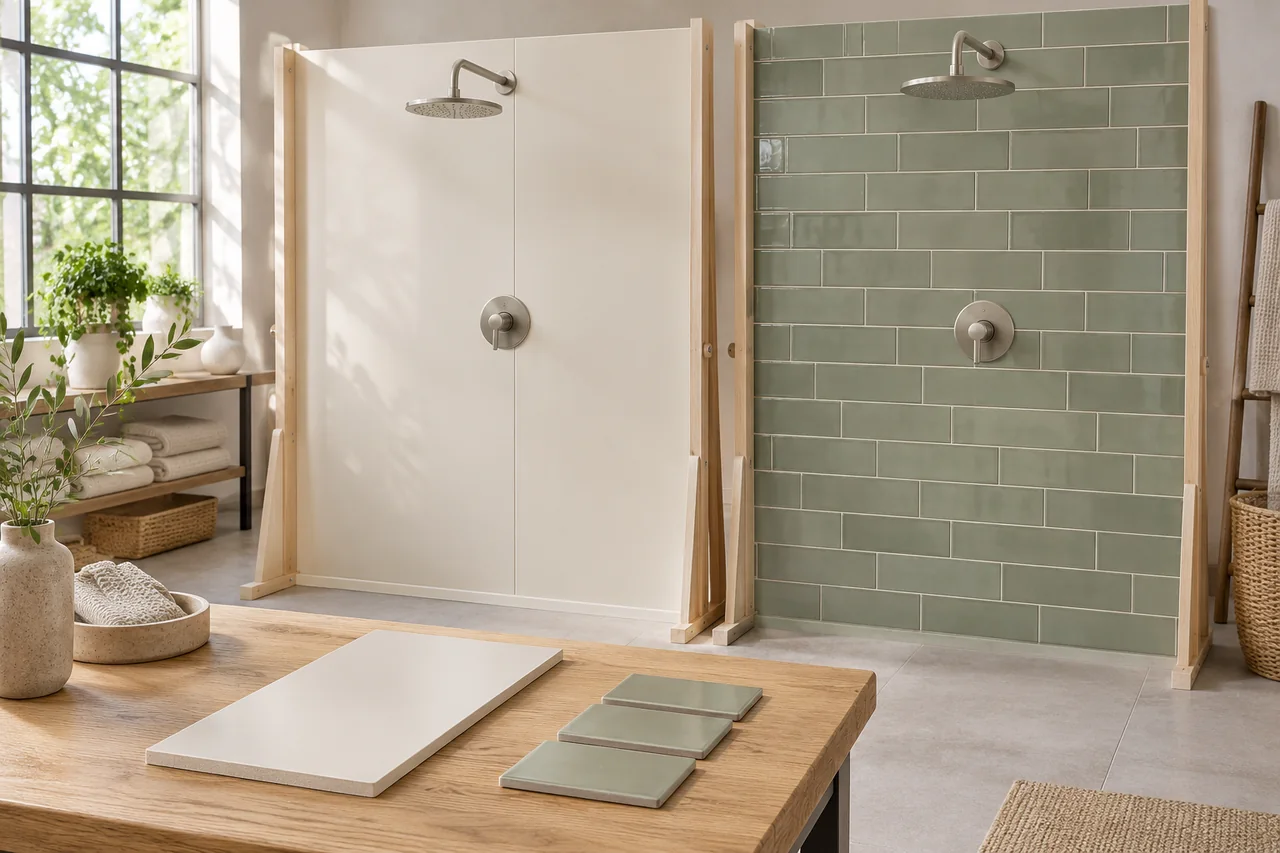
Ask the installer for a sample using the selected tile and proposed grout color, following the applicable manufacturers’ directions. Label it with both product names so it cannot be confused with a showroom swatch. Review the result together for the finish, joint appearance and any visible change to the tile. Keep a photo and note whether the combination is accepted or needs another candidate.
This is a compatibility and appearance decision, not a home test of long-term stain resistance. A successful-looking sample does not override a product’s excluded application.
Put separate use permissions on the calendar
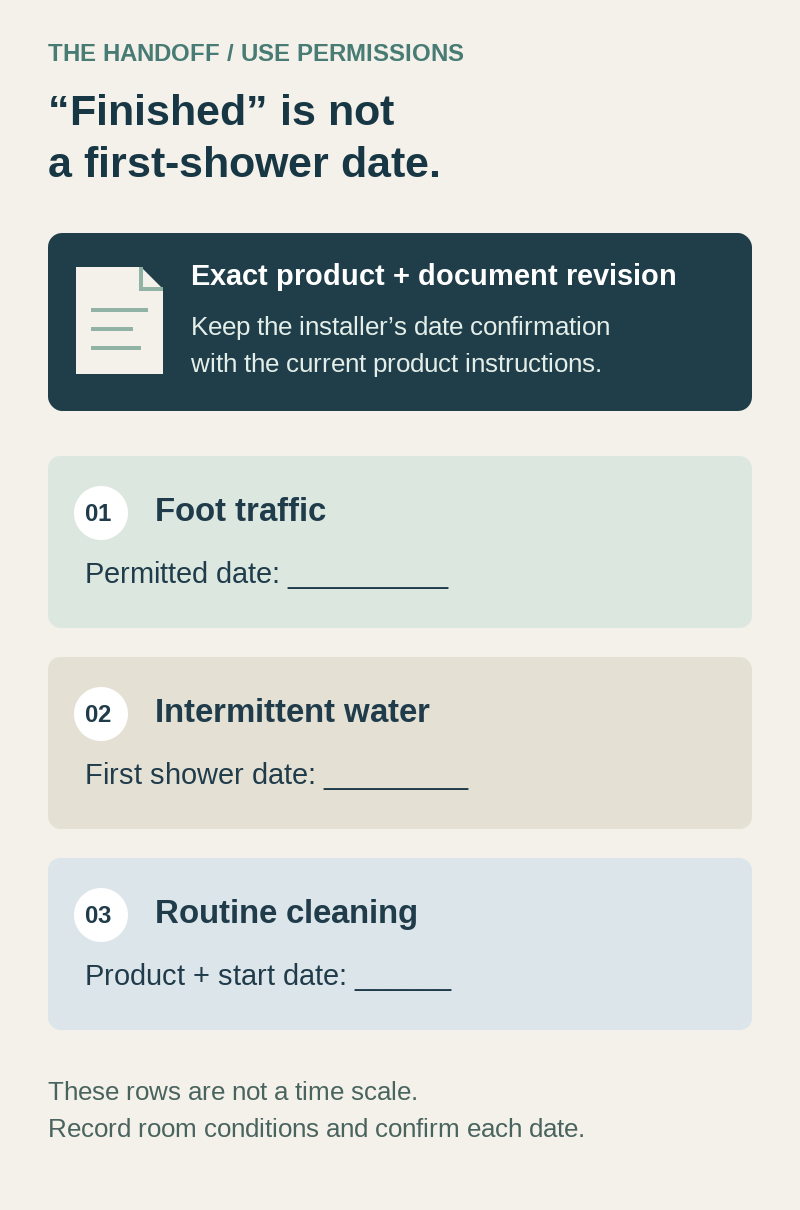
“Grouting finished Friday” is incomplete handoff information. Ask for separate permitted dates for foot traffic, first shower and routine cleaning, plus the conditions those dates assume.
For example, Flexcolor CQ calls for three days before intermittent water exposure. Its published application-properties table is based on 73°F (23°C) and 50% relative humidity, and its curing/protection times vary with temperature and humidity. Use the installer’s confirmation for the actual room; do not transfer that figure to another product or exposure.
Keep the approved cleaner and any sealer decision with this record. A grout’s maintenance instruction does not automatically cover the tile, stone or other surfaces beside it.
Keep movement joints and waterproofing separate
TCNA distinguishes joints where backing surfaces move independently from ordinary grouted field joints. Have the installer identify the movement-joint locations and appropriate sealant detail separately, even if the colors match. Grout is also not the concealed waterproofing layer; Schluter explains that distinction. Review the waterproofing checkpoints when the scope involves opening or rebuilding the shower.
Bring this grout card to the quote
Fill one card for each proposed product and zone. Send the completed card back with the quote so a later product change is visible.
| Record | What to put in the field |
|---|---|
| Product identity | Manufacturer, full model, color and document revision/link |
| Exact application | Wall, floor or feature; ordinary shower or steam exposure |
| Tile and joints | Tile model/finish and installer’s specified joint width/depth |
| Compatibility decision | Sample identifier, result and who accepted the combination |
| Handoff | Permitted traffic, first-water and cleaning dates; applicable conditions |
| Care and separate details | Approved care document, sealer decision and movement-joint specification |
When comparing bathroom-remodel quotes, attach this card to the relevant tile scope. It turns “premium grout included” into a product choice that can actually be checked before work starts.
Questions homeowners ask
What is the best grout for a shower?
Start with the exact shower application, tile/finish and joint dimensions, then check candidate product documents and a compatible sample. A family label or color match alone does not identify a suitable product.
Can ready-to-use grout be used on a shower floor?
Check the exact product. Flexcolor CQ permits intermittent wet shower floors but excludes steam, submersion and pebble/irregular tile.
Does shower grout always need sealing?
Use the exact instructions. Ultracolor Plus FA says sealing is not typically required; Flexcolor CQ requires none. Check tile care separately.
Sources & further reading
Primary sources support the factual points in this guide. Local rules and project requirements can change; use the linked authority for a current decision.
- MAPEI Ultracolor Plus FA US technical data sheet, edition August 28, 2026, currently linked EN-US document
- LATICRETE SPECTRALOCK PRO Premium US data sheet DS-681-1026
- MAPEI Flexcolor CQ US technical data sheet, edition December 10, 2025, currently linked EN-US document
- Tile Council of North America: Grout FAQ, change-of-surface joints
- Schluter US: Waterproof Shower
MAKE YOUR NEXT MOVE
Get your bathroom remodel moving.
You have done the research. Now choose your project, pick your look, and connect with bathroom contractors for the work you want done.
Start my bathroom project Already have bids? Compare them here ↗