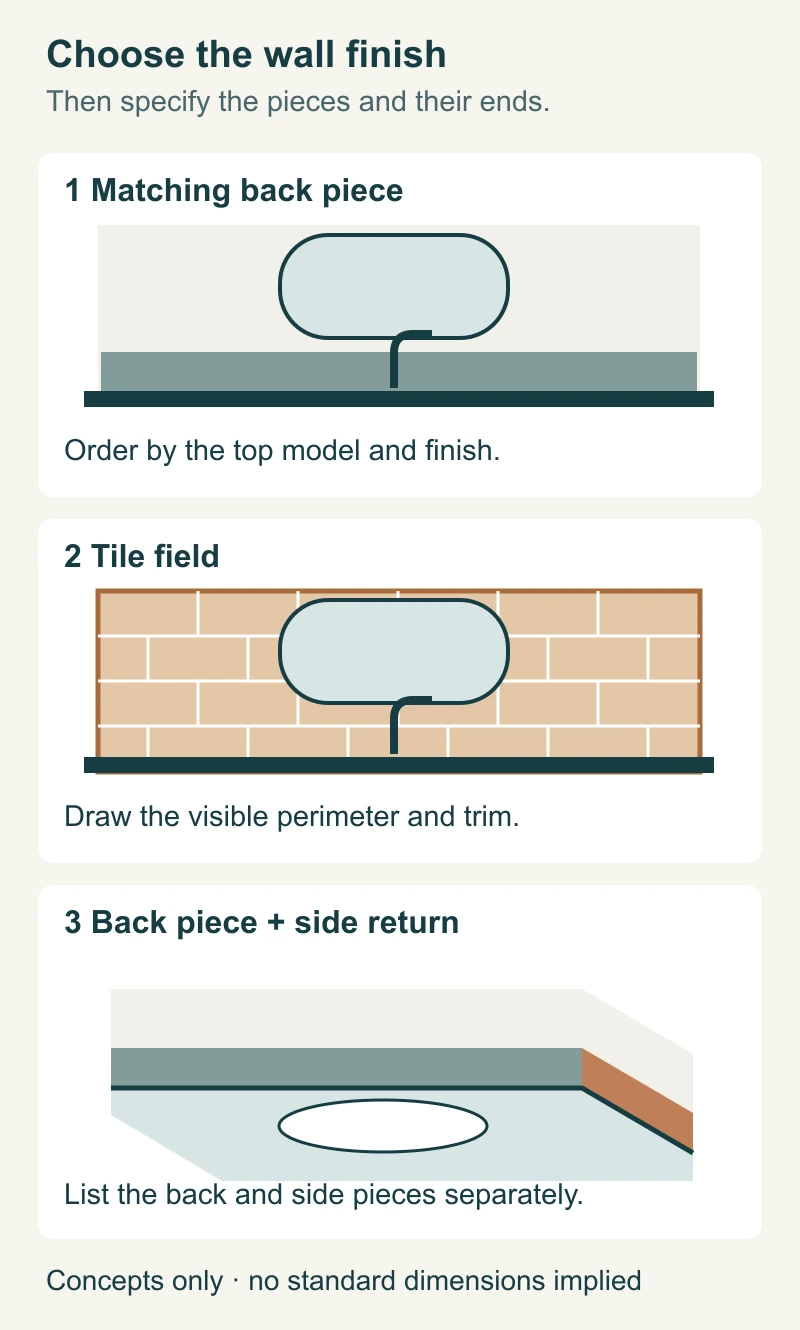
Choose a matching back piece, a tile field or a back piece with a side return. Confirm the exact top and finish, then check the product drawings against the finished wall layout. List each piece separately and agree on the corner, exposed ends and installation scope before ordering.
The backsplash looks like a finishing detail until the box arrives: the white does not match, the side piece is missing, or an unfinished end will face the doorway. Start with the exact top and the wall layout. Then decide what belongs in the order.
Choose a back piece, a tile field or a return
A matching prefabricated back piece gives the countertop a defined rear edge. A tile field makes the wall a larger design element. Adding a side return brings a second wall into the order. These are different scopes, even when the inspiration photo looks similar.
- Matching back piece: identify the top manufacturer, model, material and finish before searching for the accessory.
- Tile field: sketch its width, upper edge and exposed sides. Decide whether a separate strip belongs below it or whether that would create an extra line you do not want.
- Back piece with a side return: list both parts. Show which wall receives the return and where its front end should stop.
Place the sample against the actual top under the bathroom lighting. Look at the edge profile and thickness as well as the face color. For the separate question of cleaners, hot tools and repair, use the countertop material and care guide.
A “49-inch backsplash” is not a complete order
One manufacturer example shows why the model matters. KOHLER lists back splash K-28264 and side splash K-28266 as optional accessories for its K-28253 Silestone quartz top; the top specification says those accessories are sold separately. That is a named product pairing, not confirmation that either piece fits your walls. See the K-28253 specification.
The K-28264 drawing gives a back-piece length of 49⅛ inches, height of 3½ inches and thickness of 13/16 inch, although the product name says 49 inches. The K-28266 side-piece drawing gives 21⅝ inches by 3½ inches by 13/16 inch. Those dimensions apply to these models. They are not a rule for other brands or a cutting plan.
Save the actual drawing with the order. Ask the seller to confirm the accessory model and finish against your top, particularly if the top is older, discontinued or from a different product family. A similar color name is a starting point for checking samples, not proof of a match.
Map the finished wall and the corner
Sketch the top from above and mark every wall it meets. Record the rear run and each proposed side return separately. Include the existing strip, if one is staying. Mark visible front and end edges so the supplier knows which faces will be seen.
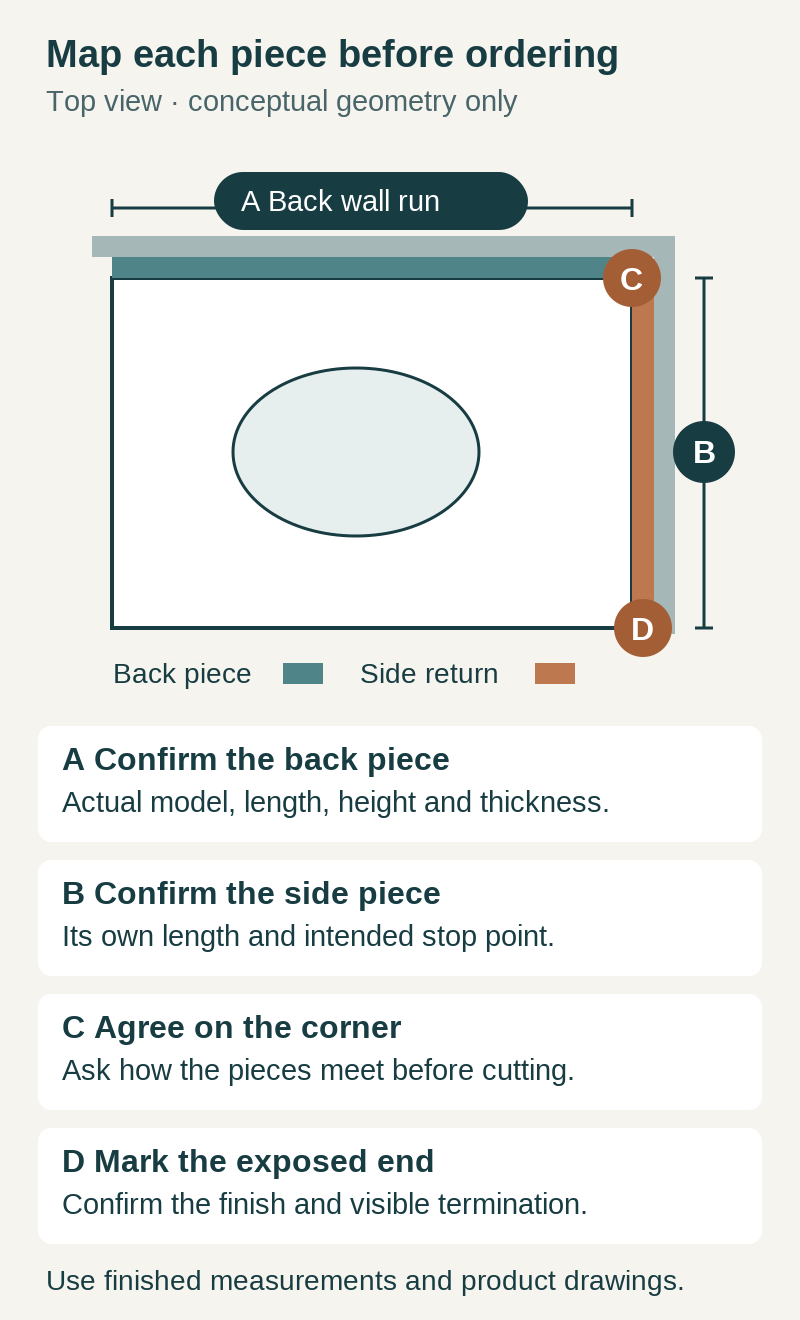
At an inside corner, ask the fabricator or installer how the back and side pieces will meet and which measurement each piece needs. Do not order two wall-length strips and assume their thickness disappears at the junction. Also ask who checks an out-of-square corner, an uneven wall or a gap discovered when the old strip comes off.
For a replacement backsplash on a retained top, photograph the old strip before removal and identify any wall finish that must be repaired. Put removal and repair responsibility in the quote. If the project also changes the top, sink or cabinet, use the whole-vanity replacement plan for that larger scope.
Test the height and visible edges in the room
Use a paper outline to compare the proposed upper edge with the mirror, recessed cabinet and faucet. Open doors and move the faucet controls through their normal travel while checking the outline. The faucet fit guide covers mounting and operating clearance in more detail.
For tile, mark the entire visible perimeter rather than choosing a tile and leaving its ends for later. Ask how the outside edges will finish, how the layout meets the top, and whether cuts at the mirror or a side wall will be visible. Have the installer confirm the wall preparation and the applicable tile-setting instructions for the proposed assembly.
A taller strip can change the appearance of the wall; it does not by itself establish how the wall assembly handles water. Keep the design decision and the installation specification together. Choose sealants, adhesives and any curing sequence from the applicable product instructions and installer’s written scope.
Give the seller a piece-by-piece order record
Take this record to the supplier before paying for separate pieces or authorizing fabrication. An unanswered row is a question to settle, not a dimension to guess.
| Record | What to write down |
|---|---|
| Top identity | Manufacturer, exact model, material and finish; retained or new. |
| Back piece | Accessory or fabricated item, drawing dimensions, finish and quantity. |
| Each side return | Its own model or specification, side of the room and intended stop point. |
| Corner and visible ends | Proposed junction, exposed edge finish and who confirms the measurements. |
| Wall work | Old-strip removal, repairs, tile perimeter and installation responsibility. |
| Order scope | Included, separately ordered or retained; cutting, installation and return conditions. |
Before accepting the delivery, compare the labels and visible finish with the written order and report any discrepancy through the seller’s process. Settle fit and finish questions before alteration. A clear piece list helps keep a small finishing choice from becoming a second purchase.
Questions homeowners ask
Should a bathroom vanity backsplash match the countertop?
A matching accessory can give the top a continuous material treatment; a contrasting tile field is another design choice. For a matching piece, confirm the exact model, finish, edge and thickness with the supplier rather than relying on a similar color name.
Is a four-inch backsplash a standard requirement?
Do not use four inches as an automatic ordering rule. Check the selected product drawing and the room layout. In the KOHLER example in this guide, the K-28264 drawing gives a height of 3½ inches; that measurement belongs to that model.
Is the side splash included with the vanity top?
Check the actual order. KOHLER lists the K-28264 back piece and K-28266 side piece as optional accessories for K-28253, sold separately. Other tops have their own included-parts lists. Write down each piece and quantity before paying.
Can I replace only the backsplash and keep the top?
First identify the retained top and ask the supplier or installer to assess the existing strip, attachment, wall condition and replacement fit. Include removal, possible wall repair and exposed-edge treatment in the quote before committing to a replacement piece.
Sources & further reading
Primary sources support the factual points in this guide. Local rules and project requirements can change; use the linked authority for a current decision.
MAKE YOUR NEXT MOVE
See a new look in your own bathroom.
Choose your upgrade and the style you want. Add your bathroom photo for a redesign preview, then take the next step with contractor options.
See my bathroom upgrade Already have bids? Compare them here ↗