Compare the exact model's overall plan dimensions and published basin length and width separately. Check the countertop opening using the applicable product template, then have the installer verify mounting, faucet compatibility and the complete space occupied below the counter. A shopping-size label or matching outside width does not settle those checks.
Bathroom sink sizes describe several different things: the fixture's outside footprint, the basin inside it and the opening cut into the countertop. Keep those measurements separate. A sink can take up more counter space without giving you a longer bowl—and matching the old outside size does not confirm that the existing opening will work.
Start with how the sink needs to feel in use. Then compare the exact model drawings with the countertop and the space underneath. That sequence gives you a useful shortlist before a fabricator or installer makes an irreversible change.
Name the measurement before comparing the number
| Measurement | What it helps you decide |
|---|---|
| Overall plan dimensions | How much space the complete sink occupies from side to side and front to back. |
| Basin dimensions | The bowl dimensions published for that model, rather than the surrounding rim or faucet deck. |
| Countertop cutout | The opening required by the correct product template and mounting arrangement. |
| Space below the counter | Whether the sink, mounting parts and connected plumbing can coexist with the cabinet interior. |
Read the arrows on the drawing, not just the title on a shopping page. Keep the manufacturer's side-to-side and front-to-back directions consistent in your notes. Also distinguish interior bowl depth from the complete fixture's exterior height. Neither the width label nor the bowl-depth figure describes all the room needed below the top.
A larger outside footprint can have a shorter basin
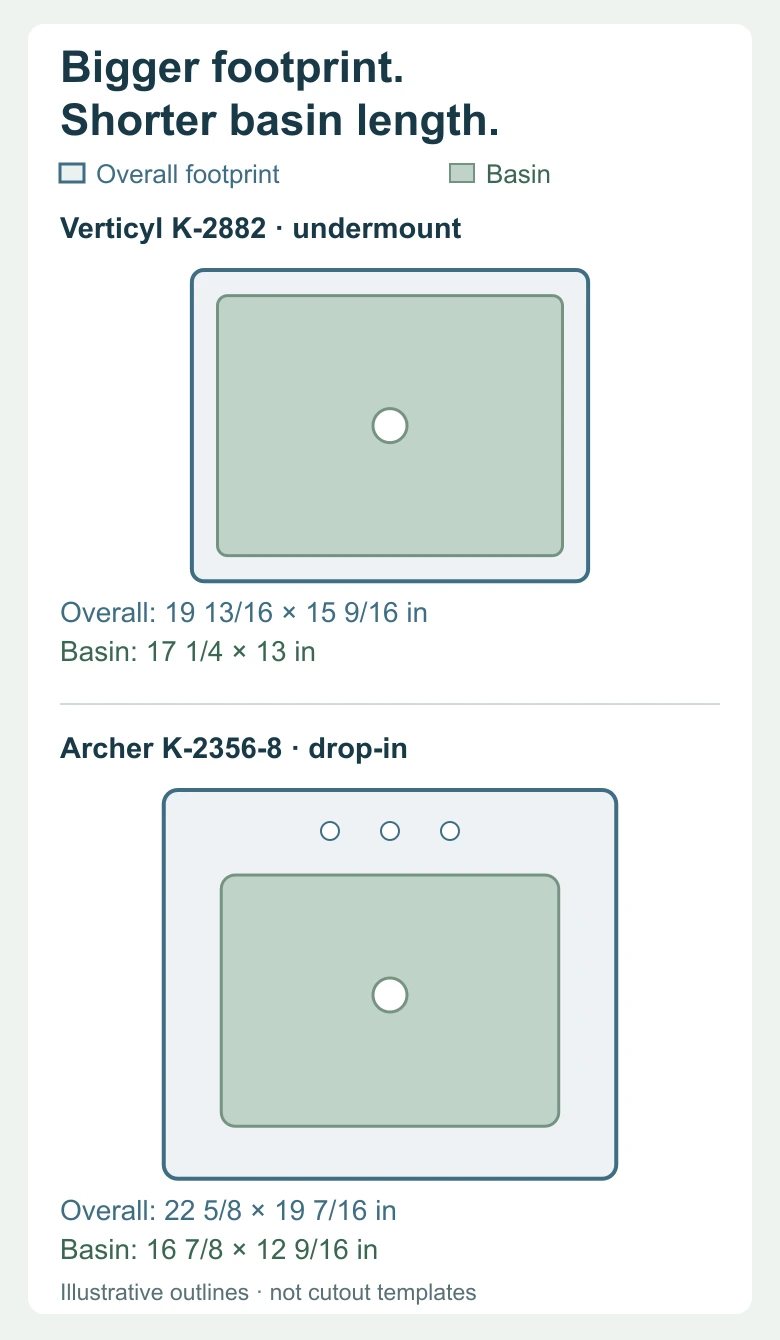
These two KOHLER examples show why the distinction matters. The figures below come from each model's current US/Canada specification: overall dimensions from its plan drawing, basin dimensions from its technical information.
| Model and mounting | Published overall plan size | Published basin length × width |
|---|---|---|
| Verticyl K-2882, undermount | 19 13/16 × 15 9/16 in | 17 1/4 × 13 in |
| Archer K-2356-8, drop-in | 22 5/8 × 19 7/16 in | 16 7/8 × 12 9/16 in |
The Archer has the larger outside dimensions in this pair, yet its listed basin length is shorter. That does not rank either sink as better. The fixture's shape, rim and deck serve different preferences. It shows why buying on overall width alone can miss the part you intended to improve.
Both sheets describe their product dimensions as nominal, subject to manufacturing tolerances. These published numbers are comparison information; they are not cutting dimensions or a substitute for the applicable template.
Test the bowl and the counter space together
Describe what bothers you about the current sink. Do your hands feel crowded under the faucet? Is the counter too busy around the rim? Is the shape awkward for a particular grooming task? Those observations are more useful than deciding that the replacement simply needs to be “bigger.”
The manufacturer's sink buying guide connects selection with household use and the trade-off between basin size and counter space. Compare your shortlist in that way. If possible, try the actual display at a normal approach position, rather than judging only from an overhead photograph.
For a new top, use paper outlines to explore the fixture's proposed outside footprint alongside the items you keep at the sink. An outline can show the remaining counter area; it cannot reproduce a curved bowl, prove comfortable water delivery or verify mounting. Keep the chosen faucet drawing beside the sink drawing and ask the installer to check them together.
Mounting details can change that comparison. K-2882 has no faucet holes and calls for a wall- or counter-mount faucet. K-2356-8 has an 8-inch widespread hole arrangement. Those facts belong to those exact models. A similar-looking sink or a different model suffix may have another arrangement.
Treat the cutout as its own decision
If you are retaining the countertop, ask the installer or fabricator to assess its existing opening and condition against the proposed product. Do not assume that a wider outside rim proves a replacement fits, or calculate a new cutout by subtracting a guessed rim width.
The K-2882 specification directs the countertop maker or cutter to the current product template. The K-2356-8 sheet requires the supplied or current KOHLER template. Save the exact model and applicable template with the fit record. A screenshot of a retailer's dimensions is a different document.
Ask who confirms whether the existing top can remain, which opening or edge changes are proposed, and when that decision must be made. If keeping the top is essential, resolve compatibility before ordering the sink. If a new top is planned, agree which actual product information the fabricator needs and who supplies it.
Look below the opening before accepting the fit
Have the installer check the complete sink below the top, including its mounting parts, against the cabinet's actual usable interior. Add the drain and plumbing arrangement to that check. A bowl-depth number does not include every component below it.
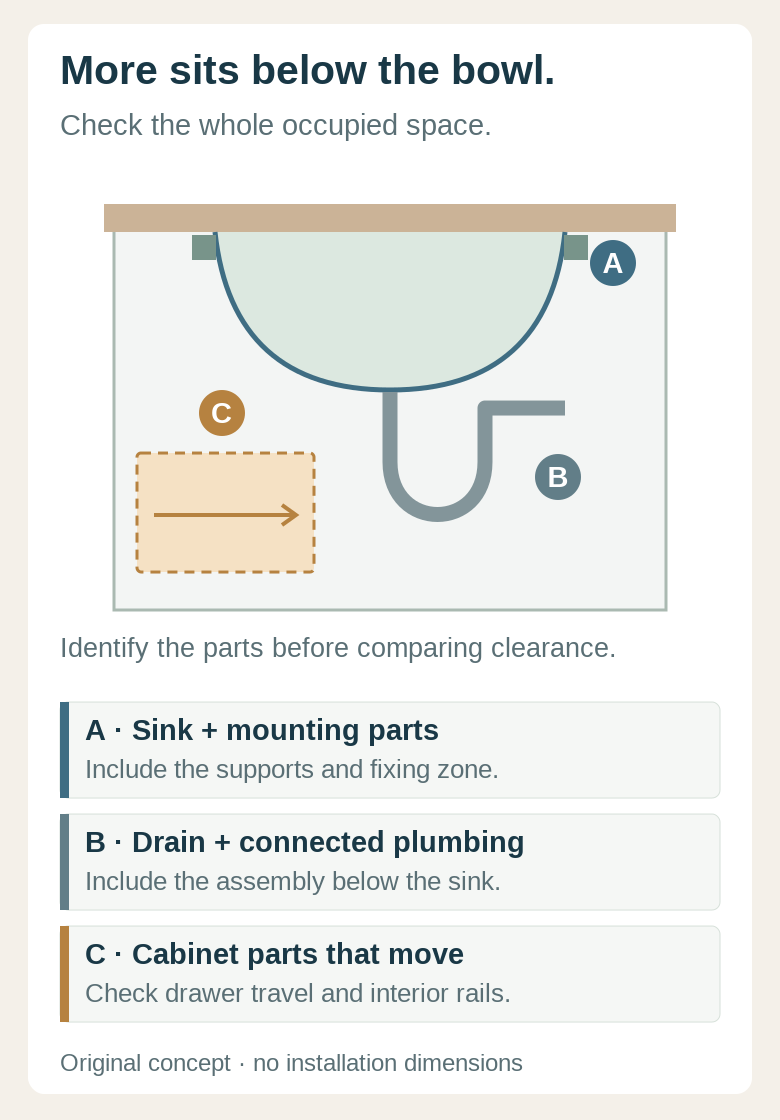
KOHLER's undermount installation guide 1199847-2-A, for example, starts with a cabinet-clearance check and coordinates countertop anchors with the sink's mounting clamps. Use the applicable instructions for the selected model and top; this is a reason to check the mounting zone, not a generic mounting method.
Keep a short sink-fit record: exact model and mounting type; overall and basin dimensions; countertop retained or replaced; applicable template; faucet arrangement; below-counter conflicts; and the person resolving each open item. Include what you want to improve in daily use, so a technically compatible substitution can still be judged against the goal.
If the cabinet or complete vanity is changing as well, bring this record into the whole-assembly vanity replacement plan. That guide covers the wider scope. Here, the decision is whether the chosen sink gives you the bowl you want and can be fitted to the actual top and space below it.
Questions homeowners ask
What size bathroom sink should I choose?
Start with the bowl you want to use and the counter space you want to retain. Compare exact product drawings, distinguishing the overall fixture from its basin, cutout and below-counter space. The right fit depends on the model, mounting, top, faucet and cabinet rather than one universal bathroom sink size.
Does a wider bathroom sink always have a longer basin?
No. In the two KOHLER examples here, the Archer has the larger overall footprint but a shorter published basin length than the Verticyl. Compare the listed basin length and width separately from the outside dimensions, which can include a rim or faucet deck.
Can I reuse the existing countertop opening?
Have the installer or fabricator check the opening and countertop condition against the proposed model and its applicable template. A matching outside size, a larger rim or the current sink's appearance does not establish compatibility.
Is basin depth the clearance needed inside the cabinet?
No. Have the complete fixture, mounting parts and connected drain and plumbing assessed against the actual cabinet interior. An interior depth figure does not describe all the components that occupy space below the countertop.
Sources & further reading
Primary sources support the factual points in this guide. Local rules and project requirements can change; use the linked authority for a current decision.
MAKE YOUR NEXT MOVE
Get your bathroom remodel moving.
You have done the research. Now choose your project, pick your look, and connect with bathroom contractors for the work you want done.
Start my bathroom project Already have bids? Compare them here ↗