Keep what still works, address active problems first and put the remaining budget into changes that solve your biggest daily frustrations. Use the priority matrix to separate a targeted finish refresh from work that needs a broader plan before products are purchased.
BEFORE YOU HIRE
Don’t overpay for your bathroom remodel.
Connect with bathroom contractors and compare the work, reviews and quote before you commit.
Check my contractor optionsA bathroom can feel dated while its most expensive parts still work. A limited budget is easier to use when you separate what needs repair, what makes everyday life awkward and what you simply want to look different. Start there, before collecting a cart full of upgrades.
The ideas below help you choose a focused refresh or recognize when the room needs a broader project. They do not assume every older fixture needs replacing, or that a coat of paint can solve a failing bathroom.
Name the result you want to notice every day
Replace “make it nicer” with a specific outcome: a less gloomy sink area, a cabinet that closes properly, an easier-to-clean bathing space or a more coordinated look. Then ask which existing parts can support that result.
Sort the work into three groups. Active problems, such as an unresolved leak or damaged material, need assessment before cosmetic spending. Daily frustrations deserve priority when the proposed change actually addresses them. Finish preferences, such as matching every metal surface, can wait if they would consume money needed elsewhere.
That order does not tell you what a repair costs. It prevents an attractive accessory from winning the budget discussion simply because it is easier to buy than the work the room needs.
Use this project-priority matrix before buying
| What bothers you? | What might stay? | Targeted idea to evaluate | What could require a broader plan? |
|---|---|---|---|
| A tired-looking vanity | A sound cabinet, usable storage and suitable basin | Adjust hardware or consider an appropriate finish refresh | Swelling, loose construction, unsuitable dimensions or plumbing changes |
| A gloomy mirror area | A useful mirror and functioning fixture | Clean the existing surfaces; check compatible lamp options before replacing the whole setup | New wiring, altered fixture positions or a different mounting arrangement |
| An otherwise useful room looks mismatched | Working tub, shower, tile and fixtures | Choose coordinated wall color, curtain and a small set of visible finishes | Products that need replacing for condition or function, not just color |
| The room feels crowded | Fixtures that serve the household | Remove unnecessary freestanding pieces and test the space before buying larger replacements | A layout or access problem that remains after the simple test |
| Paint peels or dampness keeps returning | Only materials whose condition is suitable | Identify and address the moisture problem before selecting a finish | Unresolved leaks, damaged materials or ventilation work |
Use the matrix to shortlist changes that solve your complaint and suit the actual material, product and room.
Give one change the lead role
Choose the improvement that most directly serves your main outcome. Let the remaining choices support it. If the sink area is the problem, you might investigate the cabinet's condition, the mirror and the lighting together, while leaving a serviceable tub alone. If the bathing area is failing, decorative changes elsewhere should not consume the money needed to understand that work.
Consider two hypothetical rooms. In the first, the layout works, the cabinet is sound and the owner dislikes the combination of dark walls and mismatched accessories. A coordinated finish refresh is a reasonable option to evaluate. In the second, the same appearance complaints come with recurring water damage beside the shower. That household needs the condition assessed before deciding which materials can stay.
The difference is not the owner's taste. It is the work required before the desired result can last.
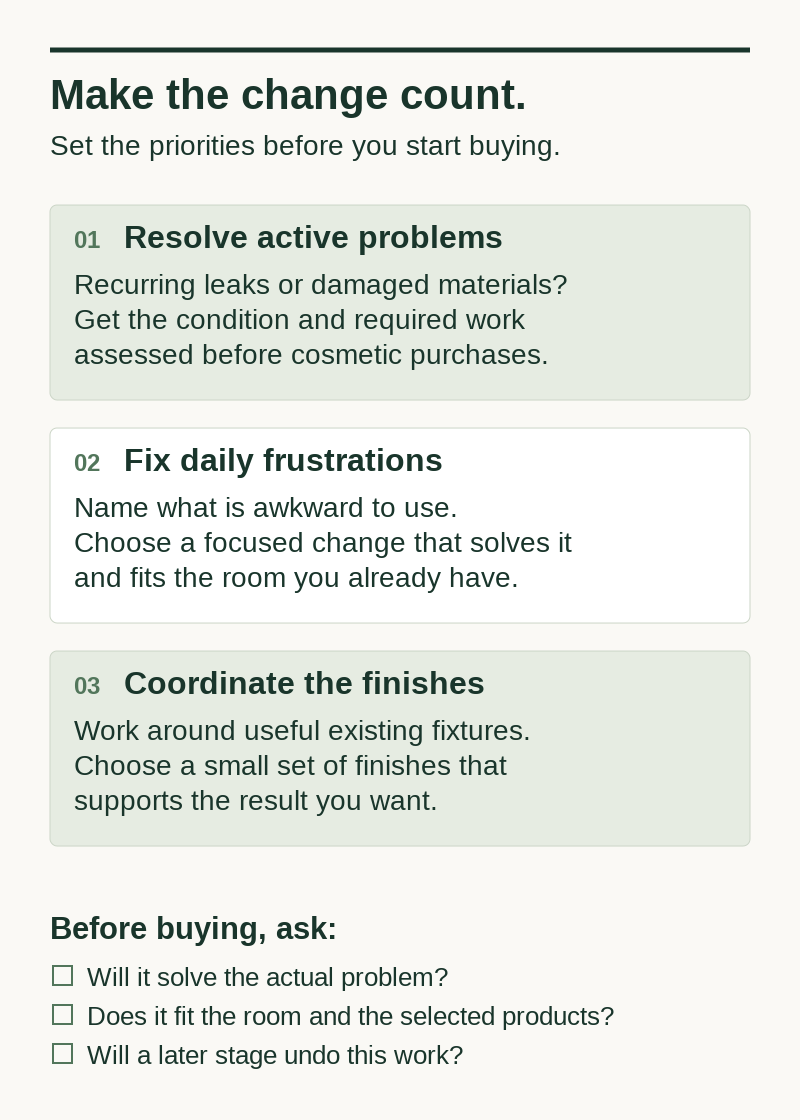
Refresh a suitable finish, not an unresolved problem
Paint can change the appearance of walls without committing you to new plumbing fixtures. But preparation and the underlying surface matter. Benjamin Moore's bathroom-painting guidance calls for cleaning and fully drying walls, with product and preparation choices suited to the surface. Follow the instructions for the actual coating rather than assuming a leftover product suits every bathroom material.
For a vanity, first separate a cosmetic complaint from a cabinet problem. If refinishing is worth investigating, check the existing finish, material, preparation and coating compatibility. If replacing pulls, verify the current fixing positions and the new hardware's dimensions before ordering. A sample door or small test is more informative than assuming an entire cabinet will look like a product photograph.
Keep moisture problems on the repair list. The EPA advises addressing the water problem when mold is present and says not to paint or caulk moldy surfaces. Cosmetic coverage is not the same as resolving the condition.
Make each replacement prove its job
Before replacing a working item, write what the new one must improve: operation, cleaning, reach, water use or appearance. Check the exact product and its installation requirements against that job. A different faucet can involve more than a different finish; a new mirror may need a different mounting arrangement.
If water efficiency is part of a necessary fixture decision, the EPA's WaterSense label identifies products independently certified for efficiency and performance. It is a useful comparison criterion, not evidence that one particular replacement will repay its installed cost within a stated time. Compare fit, function and the complete work as well.
For appearance alone, start with choices that do not demand a chain of additional replacements. A curtain, wall color and selected hardware can share a direction without every visible metal needing to match. Decide which existing finish you will accept as part of the room.
Phase the work only when the stages make sense
Ask what a later project would disturb. Painting a wall before a planned plumbing move, or choosing a floor before resolving the bathing area's edge, may create work you would need to revisit. That does not mean every task must happen together. It means the sequence should be deliberate.
Describe two options: the focused refresh you can use now, and the larger change you may want later. Ask which parts of the first option can sensibly remain in the second. Put independent cosmetic changes ahead of temporary work likely to be removed.
For product sizes and movement conflicts, use the bathroom measurement guide. For work involving systems or walls, use the permit-check method. A smaller spending limit does not answer those installation questions.
Leave with a shortlist, not a shopping marathon
Write down the main result, the active issues to resolve, the parts you intend to keep and the few changes worth pricing. Beside each proposed purchase, record the job it serves and any related work that remains uncertain. Remove items that do not earn their place.
When you need documented price context and a complete spending plan, turn to bathroom remodel costs by scope. This shortlist comes first: it explains why you would spend the money at all, and which changes you can comfortably leave for another project.
If a faucet is part of the refresh, compare the mounting layout and supplied components before choosing the finish. Confirm the actual openings, basin pairing and required parts so a small visible change does not conceal unpriced work.
Questions homeowners ask
What should I update first in a bathroom on a limited budget?
Identify any active problem requiring assessment, then choose the change that improves the daily use of the room most. A dated but functioning fixture may be worth keeping while you resolve a more important issue.
Is repainting a vanity better than replacing it?
It depends on the cabinet condition, material, usable dimensions and the finish you want. Assess whether the cabinet is sound and whether a suitable preparation and coating system is available before treating repainting as the answer.
Can I make a bathroom look more coordinated without replacing every fixture?
A focused combination of wall color, curtain and selected hardware is worth evaluating when the existing fixtures work. Decide which existing finishes you will accept instead of making every mismatch trigger another purchase.
Should I complete a bathroom refresh in stages?
Separate tasks that can remain useful from temporary work a later project would disturb. Ask how future plumbing, bathing-area or layout changes affect today's finishes before committing to the sequence.
Sources & further reading
Primary sources support the factual points in this guide. Local rules and project requirements can change; use the linked authority for a current decision.
MAKE YOUR NEXT MOVE
Don’t overpay for your bathroom remodel.
Connect with bathroom contractors and compare the work, reviews and quote before you commit.
Check my contractor options Already have bids? Compare them here ↗