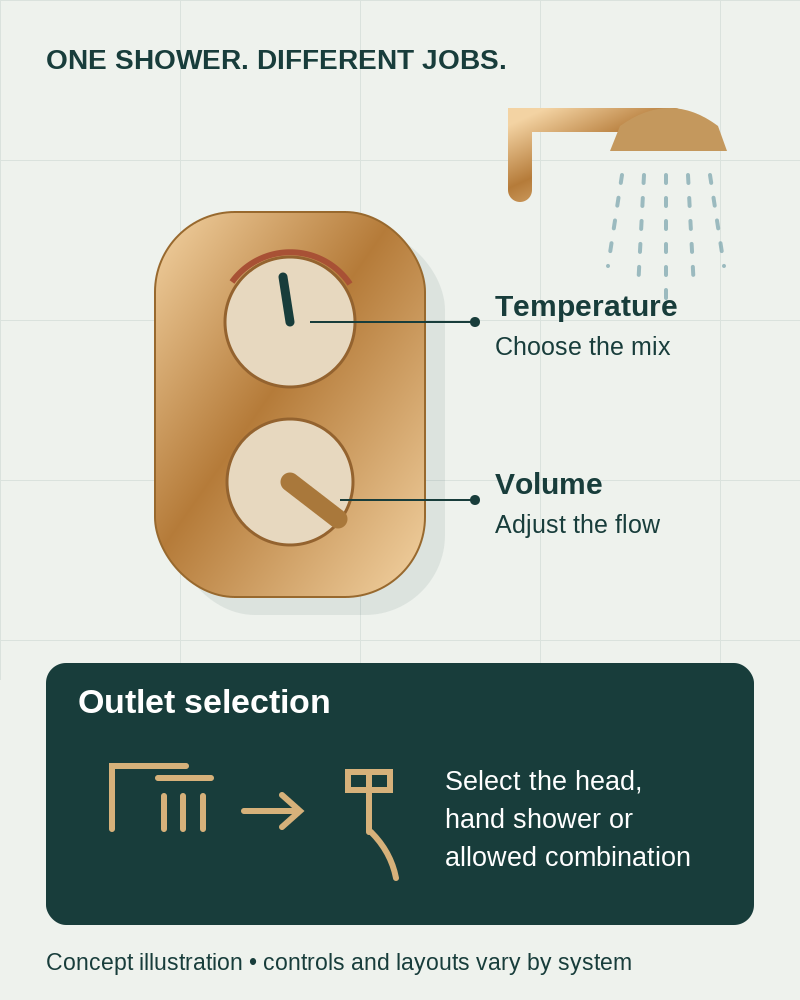
Separate temperature regulation from adjustable volume and outlet selection. Pressure-balancing and thermostatic labels do not settle every control function: confirm the exact trim, cartridge, rough-in and any separate transfer or volume components before ordering.
Shower valve types describe several different jobs: regulating temperature, adjusting water volume and choosing the outlet. Pressure-balancing and thermostatic describe temperature regulation. They do not, by themselves, tell you whether you can turn the flow down or run a hand shower alongside a showerhead.
Start with the actions you want the controls to perform. Then match those actions to a documented valve, cartridge and trim combination. A finish name and a photograph of the handles leave too much of the selection unanswered.
Separate temperature, volume and outlet selection
Use three questions while reading product descriptions or discussing a proposal:
- Temperature: How is the hot-and-cold mix controlled, and which temperature-regulating technology does the selected system use?
- Volume: Can you adjust the amount of water independently of the temperature setting, or does the main handle provide temperature selection without a separate volume adjustment?
- Outlet: Which device receives the water: showerhead, hand shower, tub spout or an allowed combination?
These functions may share a plate or sit at separate controls. The number of visible handles is therefore a clue to investigate, not a complete description of the system. On/off operation, adjustable volume and outlet selection deserve explicit answers rather than assumptions about what a second knob does.
Compare pressure-balancing and thermostatic controls
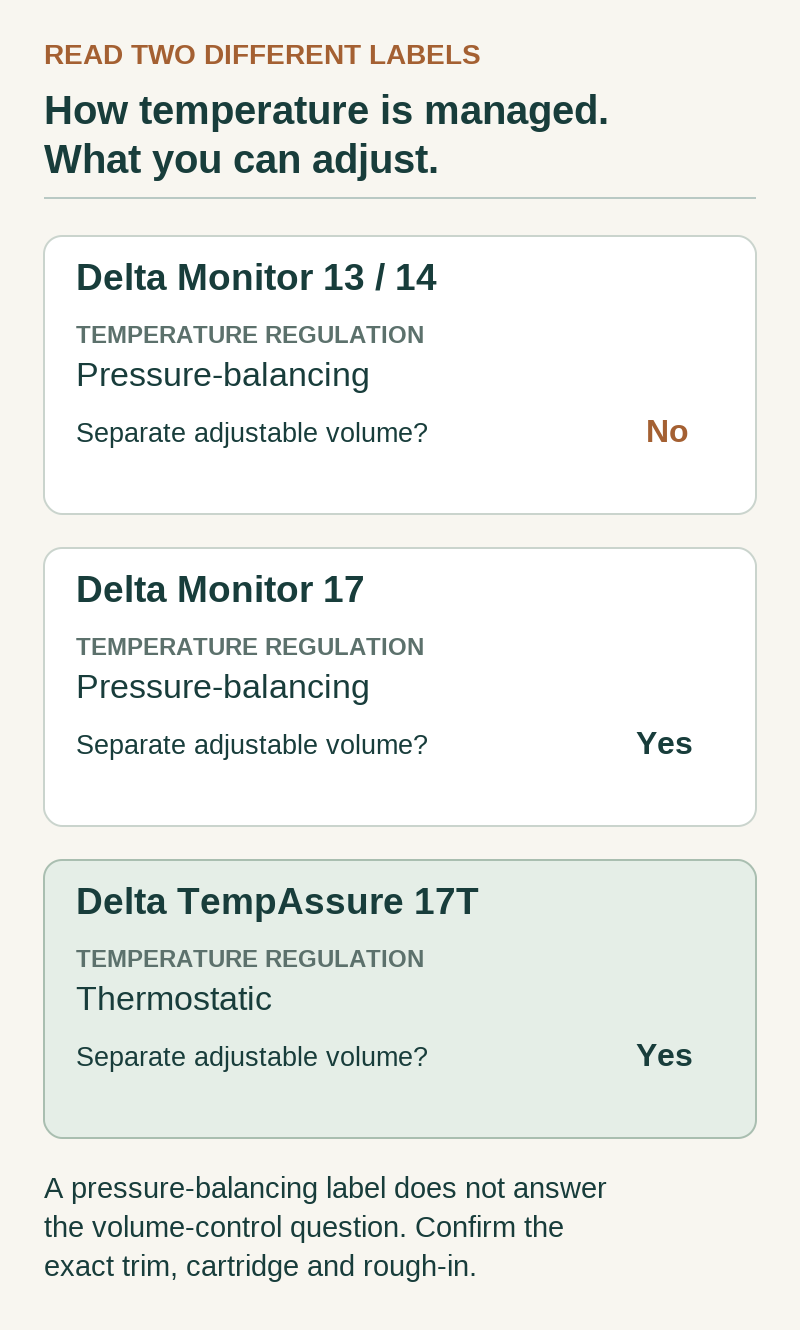
A pressure-balancing shower control responds to the balance of the incoming hot and cold supplies. For example, Delta's Zura Monitor 14 specification describes maintaining that pressure balance when another valve is operated elsewhere in the system. A thermostatic control uses temperature-sensitive regulation: Delta's Zura 17T specification identifies a thermostatic wax element, while KOHLER's K-2972-KS specification describes its temperature response to changes in inlet temperature or pressure.
That distinction still leaves the volume question open. Delta's series comparison places Monitor 13, 14 and 17 in its pressure-balancing group; the 17 adds volume control, while the 13 and 14 offer temperature control only. Its 17T uses thermostatic control. For the specific Zura T17T074 trim, the separate volume lever and temperature dial are documented in the specification.
Do not turn a technology label into a promise that water cannot become too hot. Have the responsible installer confirm the selected product's setup, temperature-limit requirements and applicable project rules. The selection here is about the controls you are buying; it does not replace those checks.
Decide whether adjustable volume matters to your routine
Imagine a household choosing controls for one fixed showerhead. One person wants the normal flow for rinsing; another wants to reduce it while keeping the temperature setting. This is a hypothetical selection exercise, not a product test or a claim about savings.
Their useful question is: “Can I change the volume without also selecting a different temperature?” In Delta's documented comparison, Monitor 17 addresses that request within the pressure-balancing family; the request alone does not establish a need for thermostatic control. The installer still needs to confirm the exact proposed assembly and its suitability for the room.
A second handle is not the only possible arrangement. The Moen 90 Degree M-CORE 3-Series specification describes volume adjustment by lifting the lever and temperature adjustment by rotating it. It names UTS3711 valve-trim, UTS3715 shower-trim and UTS3713 tub/shower-trim series, with U130 and U140 valve series. Select the actual model and finish suffix; these names are not a claim that another Moen family fits.
Thermostatic systems also vary in how volume is provided. KOHLER's MasterShower K-2973-KS has integrated independent temperature and volume controls. Its K-2974-K is a separate on/off and volume-control valve intended for use with KOHLER thermostatic mixing valves; that component's trim is sold separately. A quote saying only “thermostatic valve” does not settle the control arrangement or the full parts list.
Name the outlets and how you want to switch them
Write the devices in plain language first. For a showerhead and hand shower, decide whether you want one at a time or whether using both together is part of the request. Then ask the installer to show which settings the proposed system actually supports.
Moen's transfer-valve identification guide illustrates why the distinction matters. It lists U231 with independent functions and no shared function, while U361 offers specified independent and shared functions. These transfer valves require a suitable second valve to supply the system. The transfer selection answers where the water goes; it is a separate part of the discussion from the temperature-regulating valve.
Keep a retained tub spout in this conversation. Delta's R10000 rough-in specification specifically notes that its HF model has no tub outlet. A “high flow” label is not enough to approve that model for a plan that includes a tub spout. Ask for the exact rough-in suffix and intended outlets before accepting a substitution.
For a broader change to the bathing area, carry these choices into the tub-to-shower scope discussion. A drawing of the finished shower should agree with the list of devices and control functions in the proposal.
Identify the existing valve before a trim-only purchase
If the goal is a new finish on an existing shower, start with the valve already in the wall. Gather the original invoice, product documents, brand markings and a description of normal handle operation. Ask the manufacturer or responsible plumber to resolve the identity when those records do not establish it. Have any needed disassembly or concealed investigation handled as part of that assessment.
Moen's replacement-trim guide says the rough-in families listed in that guide do not have interchangeable trim and uses handle operation and screw locations to help identify them. A matching brand name, plate shape or finish is not the written compatibility confirmation you need.
Even a system that supports several control options has a defined boundary. Delta's R10000 specification calls for MultiChoice Universal single- or dual-function trim and says the cartridge ships with the trim. For Moen's documented M-CORE 2- and 3-Series systems, the flow cartridge also comes with the trim kit. Do not assume every rough-in box contains the final operating cartridge, or that a platform name proves compatibility with an unidentified older valve.
Keep the matched parts and project scope together
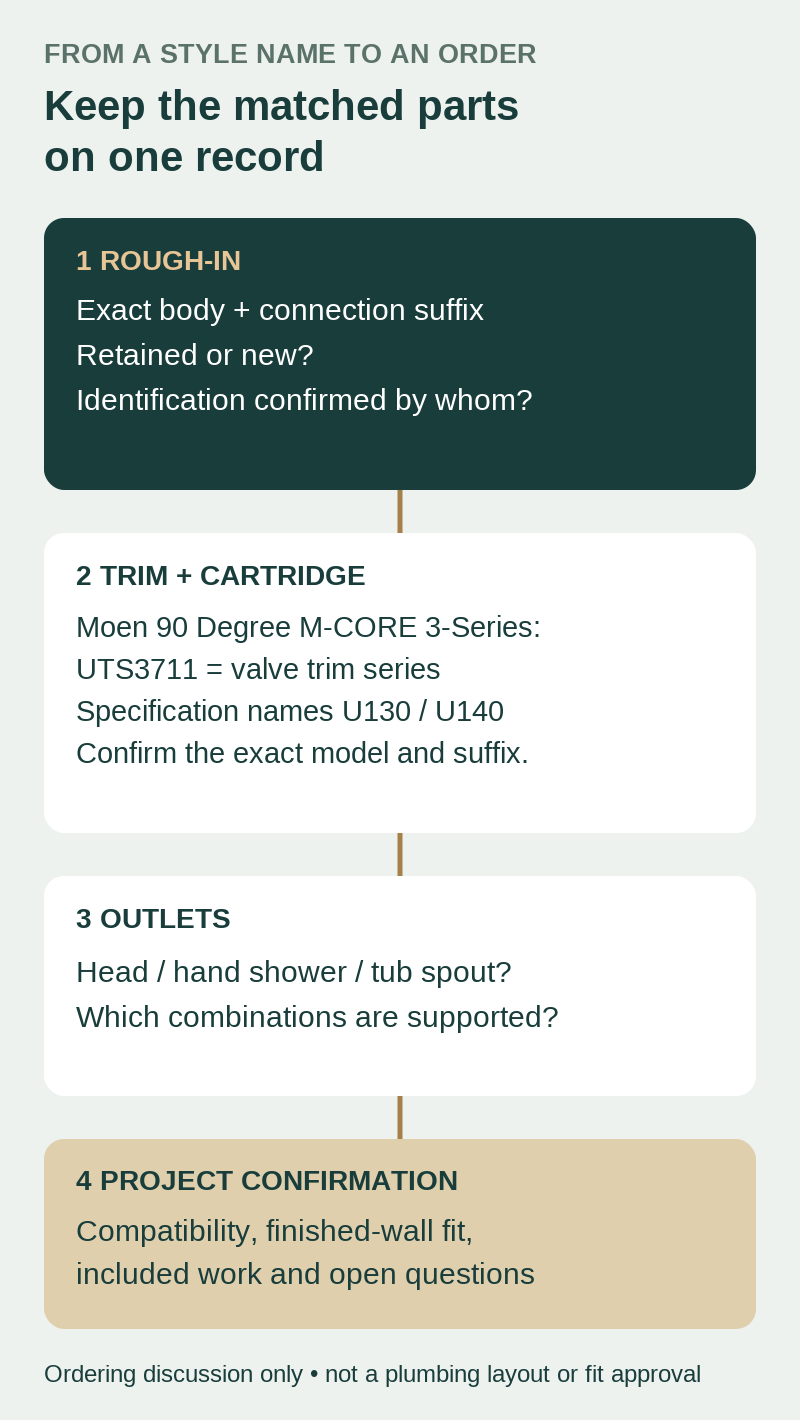
Before ordering, keep a short selection record beside the estimate:
- What stays: identified existing valve and devices, or the unresolved investigation needed.
- What operates: temperature-regulation type, independent volume preference, outlets and requested shared settings.
- What is supplied: exact rough-in and connection suffix, trim and finish suffix, operating cartridge, transfer or volume components, and separately ordered items.
- What the installer confirms: the documented combination, fit relative to the finished wall, service arrangements and the plumbing or surface work included.
Return to the hypothetical household's request: “independent volume” should appear in the proposal, followed by the exact combination that provides it. If the quoted trim changes, recheck that function as well as the finish. That is a more useful review than approving a picture whose second control has never been explained.
If replacing the valve affects the shower wall, include the opening, restoration and relevant water-management details in the work scope. Use the pre-tile waterproofing checkpoint when that work is part of the project, and the quote comparison worksheet to make the included parts and responsibilities visible across bids.
Questions homeowners ask
Does a pressure-balancing shower valve have volume control?
It depends on the documented system. Delta groups Monitor 13, 14 and 17 as pressure-balancing, but only the 17 adds volume control in that comparison. Check the exact trim and cartridge rather than relying on the temperature-regulation label.
Is a diverter or transfer valve the temperature control?
Identify its stated job in the selected assembly. Moen’s separate transfer-valve examples route water between devices and require a suitable second valve to supply the system. Ask which control changes temperature, which changes volume and which selects the outlet.
Can I change shower trim without replacing the valve?
Only when the proposed trim is documented for the identified valve and required components. Establish the existing valve family and model, then obtain confirmation for the exact trim and cartridge. Similar handles, a matching brand or the same finish do not establish that match.
Does thermostatic mean the volume control is included?
It does not completely describe the package. KOHLER K-2973-KS has integrated volume control; K-2974-K is a separate volume-control component with its own separately sold trim. Record the complete proposed assembly and supplied parts.
Sources & further reading
Primary sources support the factual points in this guide. Local rules and project requirements can change; use the linked authority for a current decision.
- Delta: Zura Monitor 14 specification
- Delta: 13/14 versus 17 shower controls
- Moen: Can I Replace My Shower Trim?
- Moen: How to Identify Your M-Core Cartridge
- Moen: 90 Degree M-CORE 3-Series specification
- Delta: Zura 17T074 thermostatic trim specification Rev G
- Delta: R10000 MultiChoice Universal rough specification Rev L
- KOHLER: K-2973-KS thermostatic valve with integrated volume control
- KOHLER: K-2974-K volume-control valve
- Moen: Independent Transfer Valves
- KOHLER: K-2972-KS thermostatic mixing valve specification
MAKE YOUR NEXT MOVE
Get your bathroom remodel moving.
You have done the research. Now choose your project, pick your look, and connect with bathroom contractors for the work you want done.
Start my bathroom project Already have bids? Compare them here ↗