
Separate the visible grate or channel, the connection to the shower’s waterproofing and the outlet connection. Compare exact documented products: a preformed-base drain, a liner-clamping drain and a bonding-flange drain describe different interfaces. Keep the selected base, drain parts and supporting documents together.
Shower drain types can describe three different things: the visible opening, the connection to the shower’s waterproofing, or the outlet that connects to the pipe. A round, square or linear grate answers the appearance question. It does not identify the concealed assembly. Start your comparison by naming what the drain must connect to, then select the matching visible parts.
This distinction matters when an estimate simply says “new shower drain,” or a shopping page shows an attractive cover without the rest of the system. Your useful next step is an identified assembly with documented connections. The examples below show how manufacturer descriptions answer different questions; they are not a ranking of brands or an installation recipe.
Separate the three meanings of drain type
Write the words from the product listing into three separate boxes. Put “linear” or “square” beside the visible opening. Put the named base, liner or bonded-waterproofing connection beside the interface. Put the actual outlet and specified connection beside the pipe. Leave a box blank when the listing does not answer it.
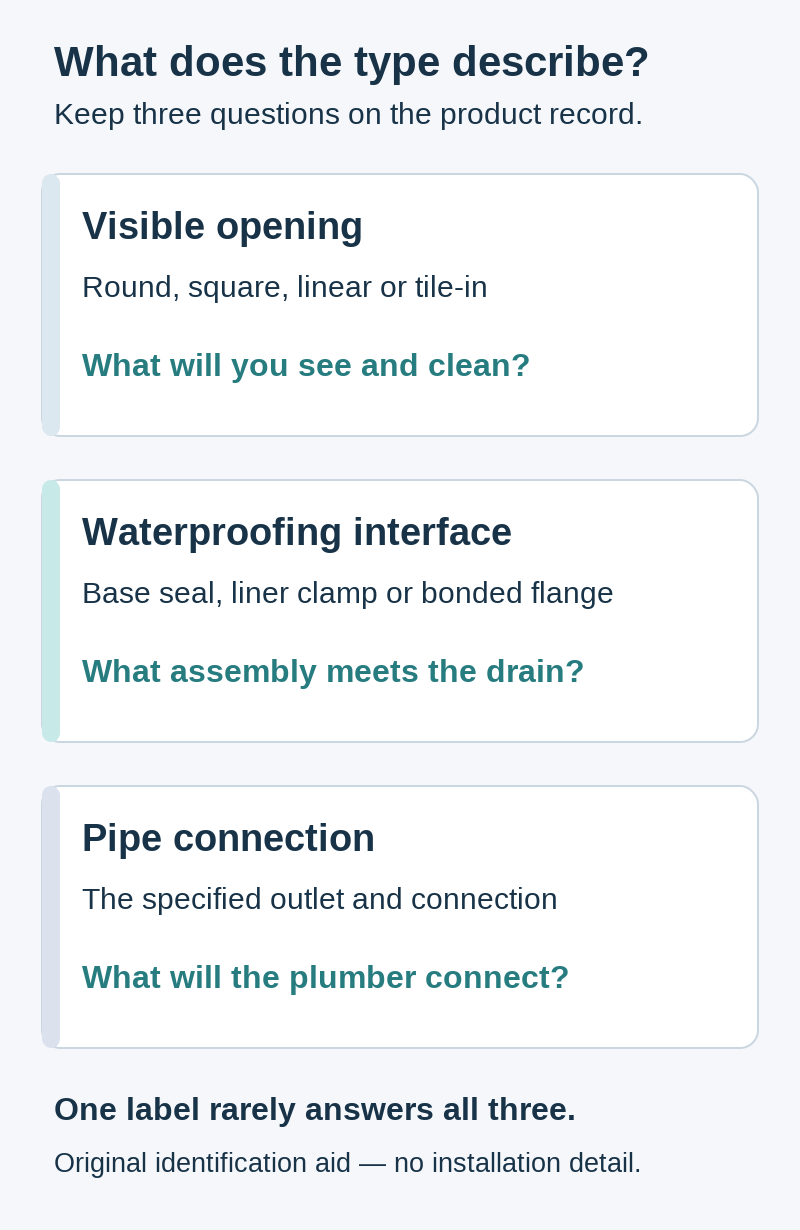
A product photo is useful for deciding whether you like a finish. It cannot fill in those missing boxes. If you are retaining a shower base, bring its exact model and current instructions to the supplier. If the floor assembly is changing, have the proposed waterproofing system identified before treating a drain as an interchangeable accessory.
Compare documented families by the connection they describe
The following manufacturer examples illustrate the distinction. They do not establish that a particular product suits your existing base, pipe or proposed shower. Keep the selected model and its own documents attached to the proposal.
| Example | Documented connection | What to resolve for your candidate |
|---|---|---|
| Oatey Plastic No-Caulk | A drain for a preformed shower base, with a washer seal at the base and a compression gasket at the pipe. | The exact base, drain body, gasket and pipe—not just a matching strainer finish. |
| Oatey Testable 130 Series ABS | A drain for a tile or marble shower base requiring a pan liner. Its description identifies a clamping collar and weep drainage from the liner. | The complete liner/drain arrangement and exact selected components. |
| Schluter KERDI-DRAIN | A point drain with an integrated bonding flange for the waterproofing membrane connection. | The specified membrane detail, drain body/outlet variant and separate grate assembly. |
| Schluter KERDI-LINE | A linear channel whose perimeter includes a bonding flange with a KERDI collar. | The named channel, outlet location, matching covering and adjoining waterproofing detail. |
Oatey’s No-Caulk guidance expressly distinguishes its preformed-base drains from drains intended for tiled shower floors. “No-caulk” is therefore not a general description for every shower drain without a visible bead of sealant. It identifies a particular product approach and still requires the selected base, body and other materials to be confirmed.
For the 130 Series, the liner connection and its weep drainage are part of the manufacturer’s description. A replacement cover does not tell you whether those concealed components are present or suitable. Do not infer the complete drain from the shape of the strainer.
KERDI-DRAIN and KERDI-LINE demonstrate why the visible shape and waterproofing question belong in different boxes. One is a point-drain family and the other is linear, while both product descriptions address a connection to bonded waterproofing. That does not approve another brand’s membrane, a different drain body or an improvised mixed assembly.
If the proposal says “linear,” ask what else is included
A long opening is an aesthetic and layout choice. The proposal still needs to identify the channel underneath, its outlet and the waterproofing connection. Schluter’s KERDI-LINE page, for example, distinguishes center and off-set outlets and lists grate assemblies separately. The long visible piece alone is not a complete ordering description.
Ask the installer to show the selected channel on the proposed floor plan and section. Discuss the floor arrangement, finished heights, water containment, maintenance access and the actual connection route as project questions. An attractive photograph does not establish that the same arrangement fits your room.
Use the curbless floor-height guide when the intended result is level entry. Use the shower pan fit guide when you need the drain coordinates for a particular base. Those are separate decisions from identifying the drain’s connection type.
Treat a retained drain or adaptor as a specific combination
When someone proposes keeping an existing drain body, ask which part stays, which parts are replaced and which current manufacturer detail supports the finished combination. Record what can actually be identified and what remains concealed. A familiar brand name or matching pipe size is not the whole answer.
A narrow example appears in Schluter’s adaptor-ring FAQ: a standard KERDI-DRAIN bonding flange with a 2-inch outlet is not compatible with the KERDI-DRAIN adaptor ring. The manufacturer identifies a separate adaptor kit containing matched parts. That answer belongs to that named combination; it is not a rule that every retained drain can—or cannot—be adapted.
If the proposed combination is unclear, ask for its product numbers and supporting document before accepting a substitution. A note saying “equivalent drain” leaves the important interface question unanswered.
Make one drain record the project team can answer
For a homeowner, the most useful deliverable is a short record that can accompany the order and the estimate. You do not need to turn the record into instructions for performing the work. Keep these entries together:
- Floor or base: exact product or proposed assembly, with the current manufacturer document.
- Waterproofing interface: exact drain body, named connection detail and any specified adaptor or matching parts.
- Pipe connection: selected outlet and the responsible plumber’s confirmation of the site pipe and connection.
- Visible parts: compatible grate, frame or tile-in support, what the order includes and how routine cleaning access works.
- Open questions: each concealed or unconfirmed condition, who will resolve it and when an answer is needed before ordering.
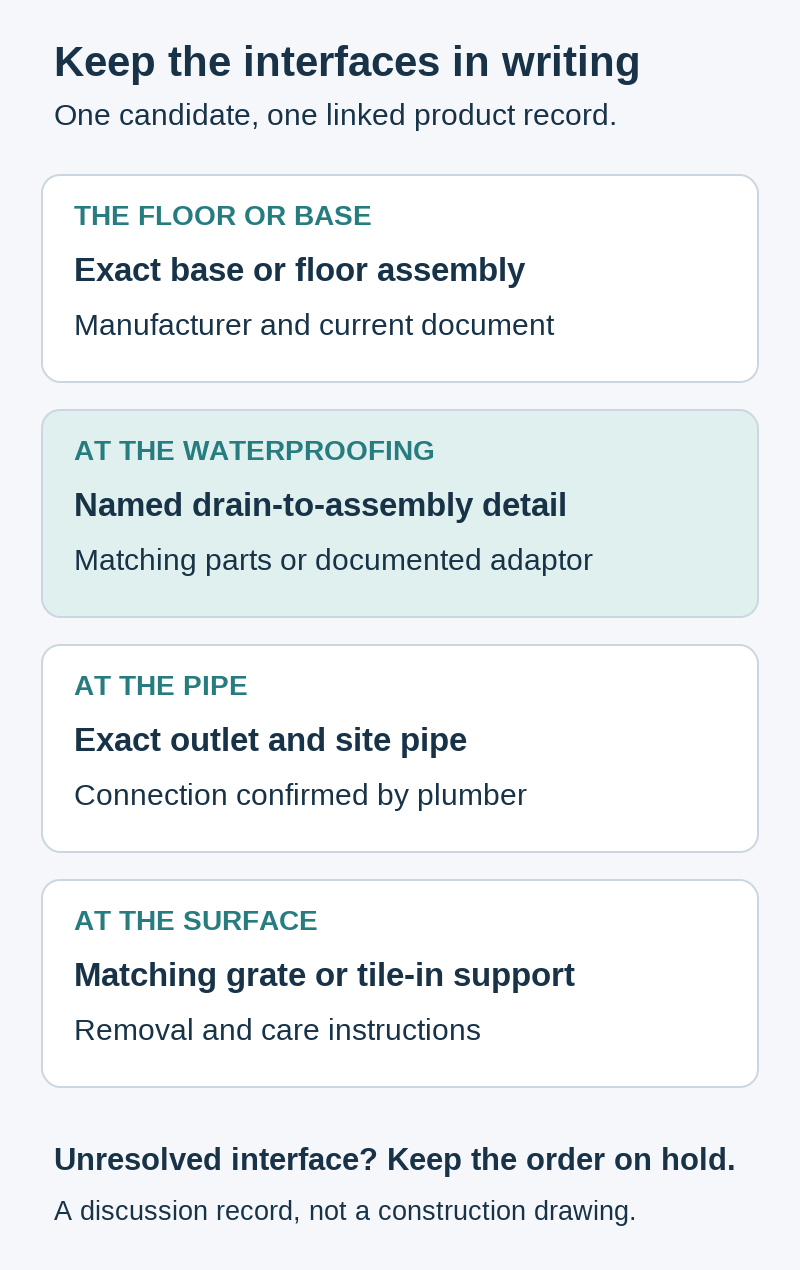
For example, an estimate that names a linear cover but leaves the channel and membrane connection blank is still missing part of the selection. Ask for those entries to be completed rather than choose between finishes on an incomplete order.
Once the product combination is identified, use the waterproofing checkpoint guide to arrange the project’s documentation before the work is concealed. Keep approval, installation and testing questions with the responsible installer, plumber and applicable authority. The goal is a drain described by its actual connections, with a visible finish you like.
Questions homeowners ask
Are round, square and linear the main shower drain types?
They describe visible shape or layout. Also identify the connection to the shower’s waterproofing and the outlet to the pipe; the shape alone does not establish those connections.
Can an Oatey No-Caulk drain be selected for any tiled shower floor?
No. Oatey’s cited guidance limits those No-Caulk products to preformed shower bases and says they are not intended for tiled shower floors. Check the selected product and complete assembly.
Does a linear drain identify the waterproofing system?
No. Name the actual channel and its documented waterproofing connection. The cited KERDI-LINE example has a KERDI collar; that does not describe every linear drain on the market.
Can I keep the old drain and add a new adaptor?
That depends on the exact existing body, new parts and supported manufacturer detail. The cited Schluter FAQ shows why a standard flange and an adaptor ring cannot be assumed to be a matching kit.
Sources & further reading
Primary sources support the factual points in this guide. Local rules and project requirements can change; use the linked authority for a current decision.
MAKE YOUR NEXT MOVE
Get your bathroom remodel moving.
You have done the research. Now choose your project, pick your look, and connect with bathroom contractors for the work you want done.
Start my bathroom project Already have bids? Compare them here ↗