Compare porcelain tile, rigid vinyl plank or tile, and sheet vinyl as complete installed systems. Confirm each exact product for the intended bathroom location, then compare the base, real joints, edges, fixtures, finished height and care before ordering.
Porcelain tile, rigid vinyl plank or tile, and sheet vinyl are three bathroom flooring options worth comparing—but compare the installed floor, not just the sample. The joints, base preparation, fixture sequence and doorway can change the choice as much as the color.
Start with the part of the bathroom outside the shower. A floor suitable beside an enclosed tub is not automatically approved inside the shower or across an open wet room. Keep those locations on separate selection records, even if you want them to look continuous.
Choose the construction before choosing the print
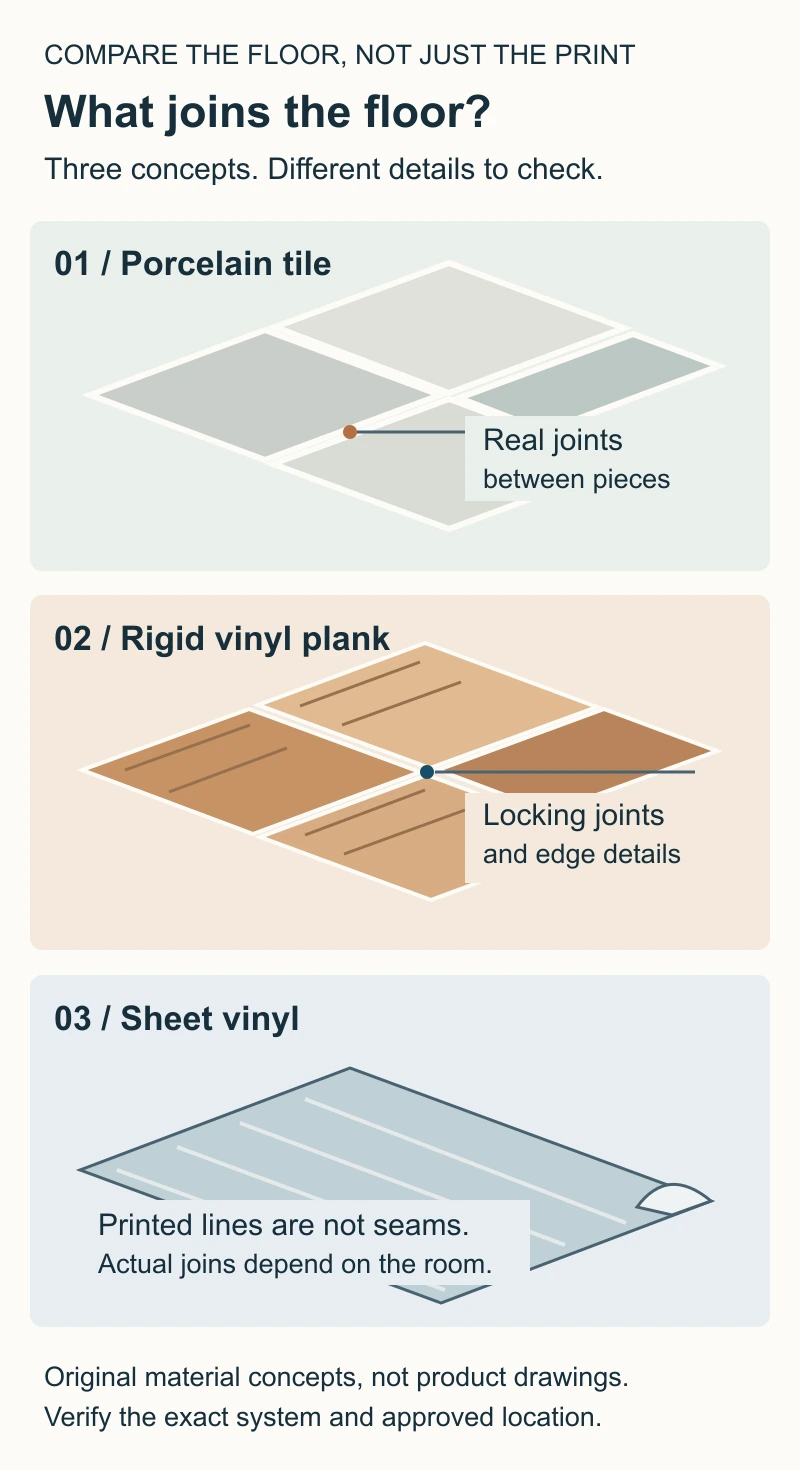
A wood-look surface might be porcelain, a locking vinyl plank or a pattern printed onto a sheet. The photograph does not tell you how it is joined or installed. Use this comparison to decide which system deserves a closer look, then obtain its exact product instructions.
| Option | Why consider it? | Resolve before ordering |
|---|---|---|
| Porcelain tile in a bonded assembly | You want individual tile shapes and a deliberate grout-joint pattern. | Exact floor-use approval, supporting assembly, joints and finished height. |
| Rigid vinyl plank or tile | You want a plank or tile appearance with a locking installation system. | Exact product's base, movement, fixture and edge requirements. |
| Sheet vinyl | You prefer a continuous printed surface with fewer actual joins when the layout permits. | Roll layout, real seam positions, installation method and perimeter details. |
These are selection routes, not a ranking of products we have tested. Compare samples of the actual shortlisted products in the room's light. Look at texture, pattern scale and how the finish works with the vanity and walls. Then put the technical information next to those visual preferences.
Porcelain: select the location and the assembly together
Floor-use approval belongs to the exact tile and finish. For example, Daltile's Synchronic White page lists a wet-and-level interior-floor application. That is a useful specification to check, not permission to transfer the same suitability to an unrelated wall tile or another finish chosen from a photograph.
The surface is only one part of a tiled floor. If waterproofing is part of the proposal, ask which complete assembly provides it. The Schluter DITRA handbook, for example, treats sealing membrane seams and floor-to-wall connections as part of its waterproofing detail. Simply naming a membrane—or buying porcelain—does not describe those connections.
Have the installer price the actual substrate preparation and installation system. Once tile is your preferred route, use the tile-format and cut comparison to settle the visible layout. This page makes the material-system choice; that guide handles the next tile-specific decision.
Rigid vinyl: the locking system changes the questions
A locking floor is not a shortcut around checking the base. The March 25, 2026 ADURA Rigid instructions describe a floating installation, require suitable subfloor conditions and specify an attached pad; an additional pad is not recommended. Those are requirements for that product, not every vinyl floor.
Ask how the selected floor will meet the tub, toilet and fixed cabinetry, and which instructions govern those details. Do not assume that adding soft underlay, fastening through a plank or trapping a floating floor beneath a fixture is harmless. Get the agreed installation sequence into the proposal before the vanity and floor are ordered independently.
Also separate a material's response to water from the condition below it. The cited ADURA instructions exclude flooding and leaking-plumbing issues from their limited warranties. A water-related product claim is not a reason to ignore an active leak or cover a damp, damaged base.
Sheet vinyl: draw the seams instead of assuming there are none
A sheet can give the room a continuous printed design without a joint at every printed tile or plank. Whether the actual floor can be laid in one piece depends on the room, available material and layout. Ask the installer to mark any real seams on the plan; a printed grout line and a cut between sheets are different things.
Mannington's March 18, 2026 Luxury Vinyl Sheet instructions offer different installation methods. They require seam sealing and describe edge and fixture details. That does not make a sheet floor a shower liner. Confirm the intended bathroom location and exact method rather than calling the whole installation “seamless” or “waterproof.”
If fewer visible interruptions are your goal, compare the proposed sheet plan with the tile or plank layout before deciding. Include any pattern match, doorway transition and retained fixture in that comparison. Ask what happens if a damaged area later needs repair, and which spare material should be kept.
Give each candidate the same five-row record
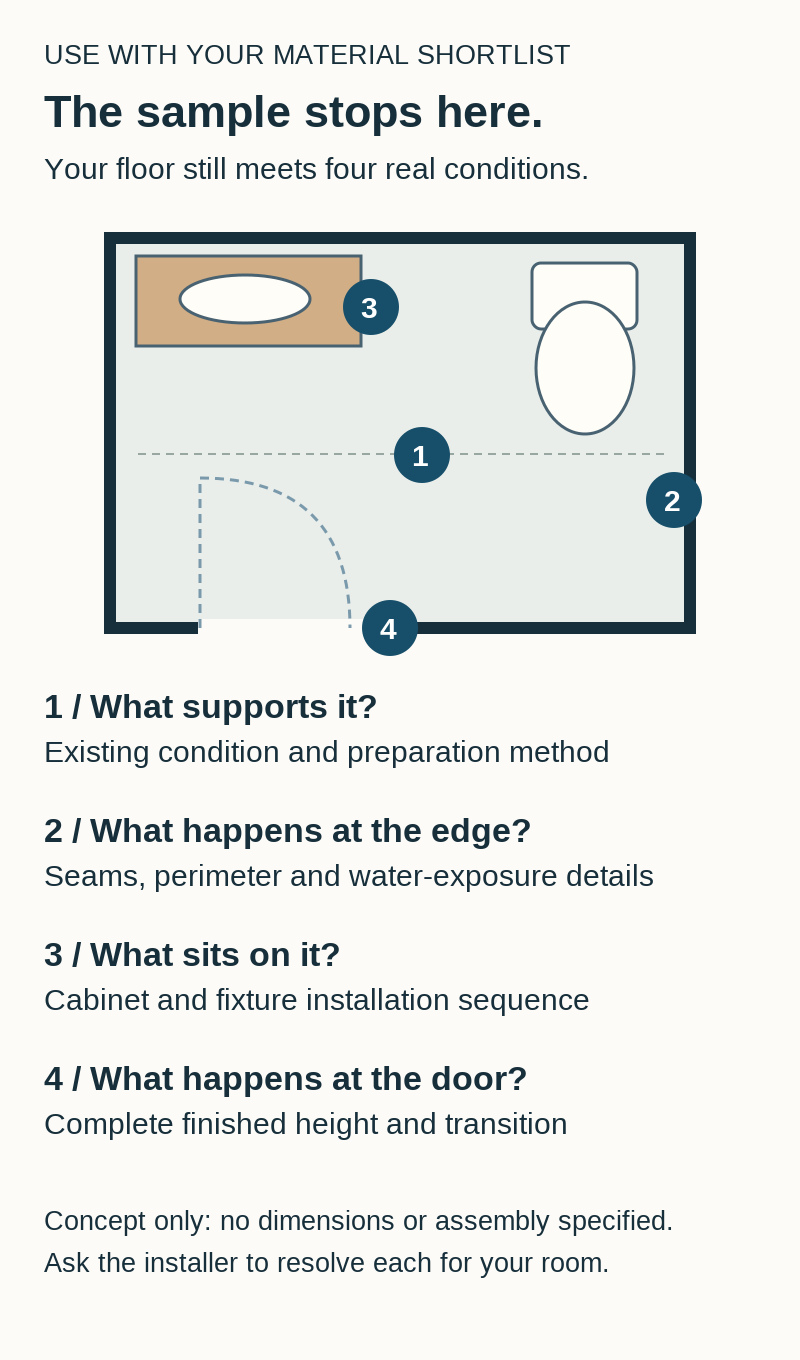
Write one record per shortlisted product: exact product and approved location; base preparation; joints and edges; finished height and fixtures; cleaning and repair. Put the relevant document or installer answer beside each row. Mark an unanswered row “unresolved” rather than treating a showroom description as confirmation.
For cleaning, obtain the selected surface's care instructions and ask about compatible mats and cleaners. For traction, ask for the product's applicable use classification and the conditions behind it. Daltile's slip-resistance guidance explains that a laboratory measurement does not establish whether a slip can occur; maintenance and actual conditions matter. Do not convert a finish name or a test number into a promise that a floor cannot be slippery.
Finally, compare complete installed proposals: removal, repairs, preparation, finish system, transitions, fixture work and cleanup. Carry the same scope into the quote-comparison worksheet. If the chosen arrangement is an open wet room or changes the shower entry, return to the wet-room planning guide before finalizing the floor. The best shortlist is the one whose appearance you like and whose unresolved installation questions have actually been answered.
Questions homeowners ask
What flooring can I use in a bathroom instead of tile?
Rigid vinyl plank or tile and sheet vinyl are options to investigate for the main bathroom floor. Verify the exact product, intended location and installation instructions; main-floor suitability does not establish shower or wet-room suitability.
Does waterproof flooring protect the floor underneath from every leak?
Do not assume so. Ask what the exact product and complete assembly cover, including joints, edges and water entering from below. Resolve existing leaks and base conditions before covering the floor.
Does sheet vinyl mean a bathroom floor has no seams?
Not necessarily. The room, material and proposed layout determine whether a real seam is needed. Ask for actual seam locations; printed tile or plank lines do not identify the joins between sheets.
Can I compare bathroom flooring by material price alone?
Compare the same installed scope. Include removal, repairs, preparation, installation materials, transitions, fixture work and cleanup, then compare the selected products and their care requirements.
Sources & further reading
Primary sources support the factual points in this guide. Local rules and project requirements can change; use the linked authority for a current decision.
MAKE YOUR NEXT MOVE
Get your bathroom remodel moving.
You have done the research. Now choose your project, pick your look, and connect with bathroom contractors for the work you want done.
Start my bathroom project Already have bids? Compare them here ↗